
Brinjal Long Seeds – Desi | WINTER / SUMMER | دیسی لمبا بینگن
October 11, 2026
Sweet Corn White Seeds – Desi | SUMMER | سفید سویٹ کارن
October 11, 2026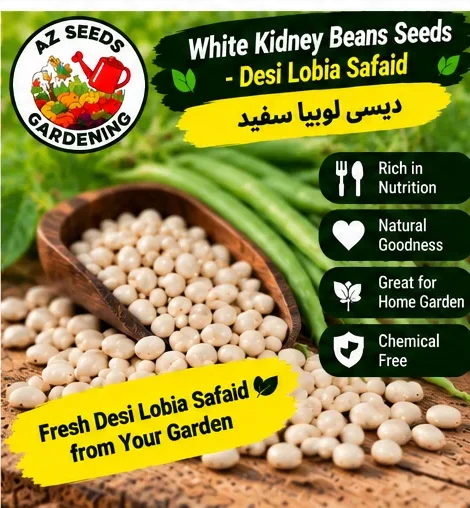
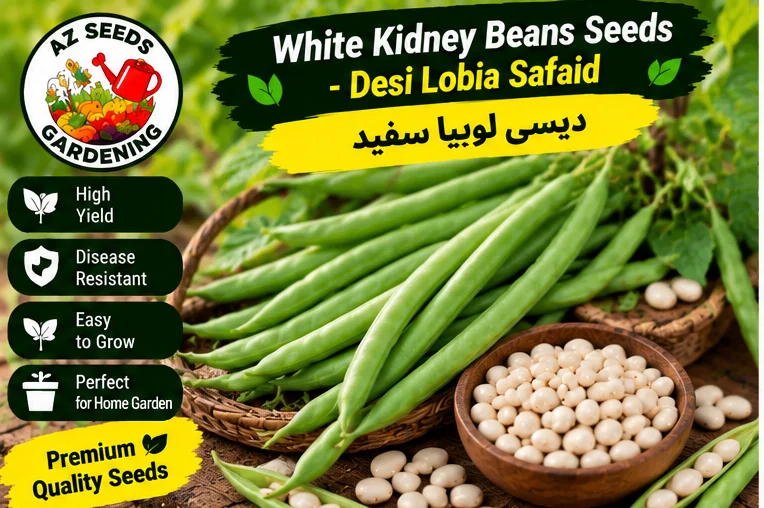
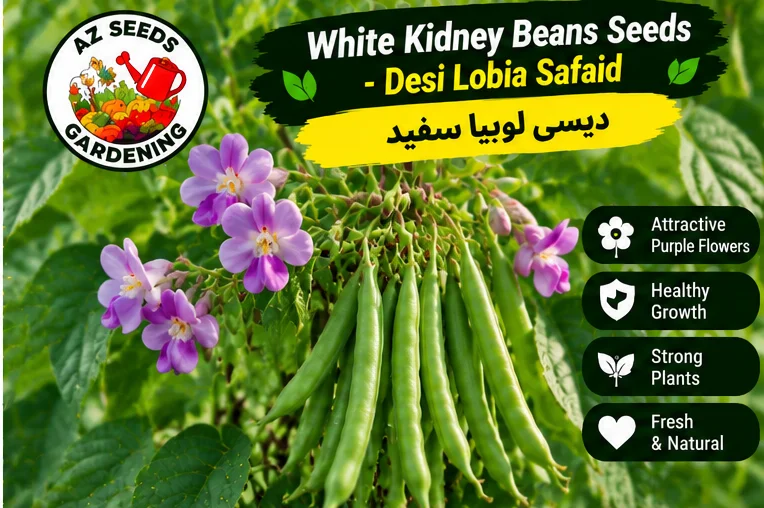
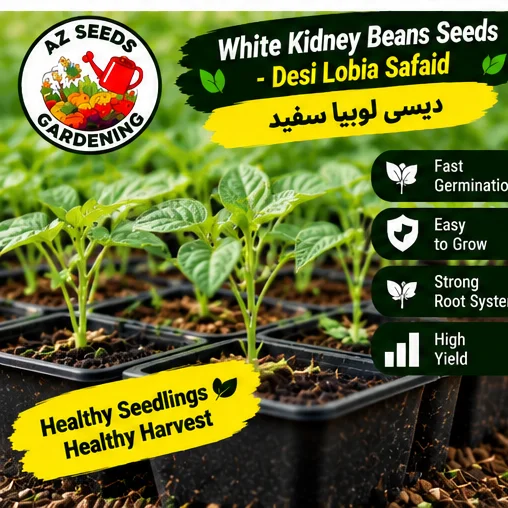
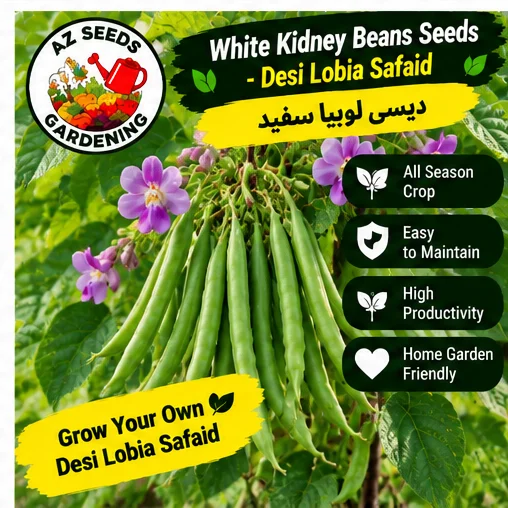
White Kidney Beans Seeds – Desi Lobia Safaid | دیسی لوبیا سفید | WINTER / SUMMER
₨ 150
Price: PKR 150 per pack
Approx. 60–70 seeds per pack.
Image Disclaimer: Product images are AI-generated for visual representation only. Actual plants, fruits, vegetables, flowers, crops, colours, shapes, sizes, and appearance may vary depending on variety and growing conditions.
Image Disclaimer: Tamam product images AI-generated hain aur sirf visual representation ke liye hain. Asal poday, phal, sabzi, phool ya fasal ki shakal, rang, size aur overall appearance variety aur growing conditions ke mutabiq mukhtalif ho sakti hai.
Grow White Kidney Beans / Desi Lobia Safaid (دیسی لوبیا سفید) from seeds supplied by AZ Seeds & Gardening.
This product is locally marketed as Desi Lobia Safaid / دیسی لوبیا سفید and belongs to the common bean species Phaseolus vulgaris. Plants produce pods containing developing seeds and can be grown for mature dry-bean production.
This product is confirmed as Desi.
Suitable for home gardens, raised beds, open soil and appropriately sized containers or grow bags.
Botanical Name: Phaseolus vulgaris
Seed Type: Desi
Common / Local Name: Desi Lobia Safaid / دیسی لوبیا سفید
Product Type: White Kidney Bean / Common Bean Type
Pack Size: Approx. 60–70 seeds
Growing Method: Direct sowing preferred
Germination Time: Generally approximately 6–10 days under suitable conditions
Growing Conditions: Mild to warm, frost-free conditions
Suggested Sowing Period in Pakistan: Generally February–April and August–October, adjusted according to local temperature and regional conditions
Variety Description
This product is marketed as:
White Kidney Beans / Desi Lobia Safaid (دیسی لوبیا سفید)
The crop belongs to:
Phaseolus vulgaris
Plants develop flowers followed by pods containing developing seeds. For mature dry-bean production, pods are allowed to progress toward maturity and drying before the seeds are collected.
Because the exact cultivar or seed strain has not been independently established, AZ Seeds & Gardening does not guarantee:
- Exact seed size
- Exact seed shape
- Exact shade of white
- Exact pod length
- Exact plant height
- Bush or climbing habit
- Exact maturity period
- Exact number of pods
- Exact number of seeds per pod
- Exact yield
- Uniformity
- Storage duration
- Heat or cold tolerance
- Disease resistance
- Pest resistance
The term Desi does not automatically establish that this seed is heirloom, open-pollinated or a specific registered cultivar.
Key Features
- White Kidney Beans
- Desi Lobia Safaid / دیسی لوبیا سفید
- 60–70 seeds per pack
- Botanical species: Phaseolus vulgaris
- Desi seed type
- Common bean / dry bean type
- Direct sowing preferred
- Suitable for home gardens
- Suitable for raised beds
- Suitable for open soil
- Can be grown in appropriately sized containers or grow bags
- Support may be required if the particular seed strain develops climbing growth
Recommended Grow Bags
White Kidney Beans / Desi Lobia Safaid can be grown in containers where adequate growing-medium volume, spacing and drainage are provided.
G-12 Grow Bag – 12 × 12 inch
Can accommodate a small planting where adequate spacing and crop care are maintained.
G-15 P Grow Bag – 15 × 14 inch
Provides additional growing-medium and root-zone volume.
G-24 Grow Bag – 24 × 12 inch
Can accommodate a larger planting where plants are appropriately spaced.
Actual plant capacity depends on container dimensions, growing-medium volume, plant spacing, actual growth habit, watering, nutrition and support requirements.
Avoid severe overcrowding.
Recommended Soil / Growing Medium
Use loose, fertile and well-drained soil or growing medium.
Suitable root-zone conditions include:
- Good drainage
- Adequate aeration
- Moderate moisture retention
- Loose soil structure
- Appropriate fertility
A practical approximate soil pH range is:
6.0–7.0
Bhalu Mitti and properly decomposed Vermicompost may be incorporated where appropriate. A fixed 50% Bhalu Mitti + 50% Vermicompost mixture is not compulsory.
Adjust the growing medium according to existing soil texture, drainage, fertility, organic-matter content and container conditions.
Avoid continuously saturated or severely compacted soil.
Growing Instructions from Seeds
1. Direct Sowing
Common beans are generally suitable for direct sowing into their final growing location.
Sow when conditions are sufficiently warm and frost risk is low.
Sowing Depth: Approximately 2–3 cm
Cover with loose soil and water gently. Avoid excessively deep planting.
2. Germination
Seeds generally germinate within approximately:
6–10 days under suitable conditions
Maintain adequately moist but well-drained conditions.
Actual germination can vary according to:
- Seed storage and handling
- Seed condition
- Soil temperature
- Moisture
- Sowing depth
- Growing medium
- Drainage
- Weather conditions
100% germination is not guaranteed.
3. Seedling Care
After emergence, provide:
- Good natural light
- Adequate airflow
- Appropriate moisture
- Frost-free conditions
- Sufficient growing space
Avoid excessive irrigation around young plants.
4. Sunlight
Established plants generally benefit from approximately:
6–8 hours of direct sunlight daily
under suitable temperatures.
5. Plant Spacing
A practical general guideline is approximately:
10–15 cm between plants
For open-ground cultivation, approximately:
45–60 cm between rows
may be used as a general starting reference.
Spacing should be adjusted according to the actual growth habit of the plants.
6. Growth Habit & Support
Common bean cultivars can vary considerably in growth habit.
Plants may develop:
- Compact growth
- Bush-like growth
- Semi-climbing growth
- Climbing growth
Because the exact cultivar has not been established, no particular growth habit is guaranteed.
Where climbing growth occurs, provide an appropriate trellis, netting, bamboo stakes or string support.
7. Watering
Maintain reasonably consistent soil moisture during vegetative development, flowering, pod setting and seed development.
Avoid:
- Prolonged severe dryness
- Repeated wilting
- Continuous waterlogging
- Standing water
- Extreme dry-to-wet fluctuations
As pods approach full dry-bean maturity, unnecessary irrigation can generally be reduced where weather conditions permit natural drying.
8. Feeding
Beans belong to the legume family.
Legumes can form associations with compatible nitrogen-fixing bacteria, but effective nitrogen fixation depends on suitable microorganisms, soil conditions and other factors.
Therefore, nitrogen fixation should not be assumed to meet all plant nutrient requirements.
Use fertilizer according to existing soil fertility, plant condition and growth stage. Avoid unnecessary excessive nitrogen application.
9. Flowering & Pollination
Common bean flowers are generally capable of:
Self-pollination
Insects may also visit flowers and contribute to pollen movement.
Not every flower is guaranteed to develop into a mature pod.
10. Pod & Seed Development
Following successful flowering and fruit set, pods develop and seeds inside gradually enlarge.
For mature dry-bean production, pods are allowed to continue developing toward maturity and drying.
Exact pod dimensions, seed dimensions, seeds per pod and development period can vary according to genetics and growing conditions.
11. Mulching & Weed Management
A light layer of suitable organic mulch may be applied around established plants where appropriate.
Keep the growing area reasonably free from aggressive weeds, particularly during early establishment.
Avoid piling continuously wet mulch directly against plant stems.
Pest & Disease Monitoring
Depending on location and season, common beans may be affected by pests such as:
- Aphids
- Whiteflies
- Mites
- Beetles
- Caterpillars
- Pod-feeding insects
Monitor plants for symptoms such as:
- Leaf spots
- Rust-like symptoms
- Unusual yellowing
- Wilting
- Stem problems
- Root problems
- Pod damage
Maintain appropriate spacing, airflow, drainage and irrigation.
No pest- or disease-resistance claim is made for this Desi seed line.
Harvesting for Mature Dry Beans
For mature dry-bean production, allow pods to progress toward full maturity.
Harvest when pods have become sufficiently:
- Mature
- Dry
- Papery
and the seeds inside have become:
- Firm
- Hard
- Fully developed
Exact pod colour at maturity can vary, so brown colour should not be treated as an absolute requirement.
After harvesting, shell the mature seeds once pods are sufficiently dry.
Drying & Storage After Harvest
Harvested mature beans intended for storage should be adequately dried before storage.
Provide dry, well-ventilated conditions and protection from excessive moisture.
Once adequately dried, harvested beans should be protected from:
- Moisture
- Excessive humidity
- Insects
- Contamination
No exact storage duration is guaranteed because storage performance depends on moisture content, temperature, humidity, container conditions and pest exposure.
Suggested Sowing Season in Pakistan
A broad practical sowing reference is:
February–April
August–October
These periods are general guidance rather than fixed nationwide planting dates.
Adjust sowing according to:
- Local temperature
- Frost risk
- Regional climate
- Seasonal weather
- Excessive heat
- Local growing conditions
Important Information About Desi Seeds
This product is confirmed as:
Desi
The term Desi does not automatically mean:
- Open-pollinated
- Heirloom
- Hybrid
- F1 Hybrid
- Bush type
- Climbing type
- High yielding
- Early maturing
- Disease resistant
- Pest resistant
Specific characteristics should only be stated where reliable information applicable to the exact seed line is available.
Important Seed Information
Seeds supplied by AZ Seeds & Gardening are intended for agricultural, horticultural and gardening purposes, including sowing and plant cultivation only.
The supplied seeds themselves are not sold as food, animal feed, edible-oil material, medicine or dietary supplements.
Do not:
- Eat or consume the supplied sowing seeds
- Feed the supplied seeds to livestock, poultry, pets or other animals
- Extract edible oil from the supplied seeds
- Prepare beverages, extracts or supplements from the supplied seeds
- Use the supplied seeds for medicinal or therapeutic purposes
- Use the supplied seeds inconsistently with their intended agricultural or gardening purpose
The fact that mature White Kidney Bean / Desi Lobia Safaid plants may ordinarily produce edible beans does not mean that seeds supplied for sowing are sold as food or feed.
Where a seed packet is specifically identified as treated, coated or otherwise processed, follow all warnings and handling instructions appearing on that packet.
Germination & Growing Disclaimer
Seeds are biological products, and germination, plant development and crop performance can naturally vary.
Information concerning germination time, temperature, sowing depth, spacing, sunlight, sowing season, flowering, pod development, harvesting, drying and storage is provided as general cultivation guidance and not as a guarantee of results.
Actual performance may be affected by seed storage and handling, genetics, soil or growing medium, temperature, weather, sowing season, sowing depth, moisture, drainage, sunlight, spacing, nutrition, pollination, pests, diseases and general crop management.
AZ Seeds & Gardening does not guarantee 100% germination, exact plant habit, exact seed or pod size, exact colour, exact yield, exact maturity or harvest time, exact number of pods or seeds, storage duration, uniformity, heat or cold tolerance, disease resistance, pest resistance or identical crop performance under all growing conditions unless a specific characteristic is expressly supported by verified information applicable to this particular seed line.
Reviews
There are no reviews yet.