
Cowpea / Rawan Beans/ French Beans / Green Beans Seeds – Desi | SUMMER| رواں کی پھلیاں
October 11, 2026
Bottle Gourd Seeds – Desi Kadu Gol | SUMMER | دیسی کدو گول
October 11, 2026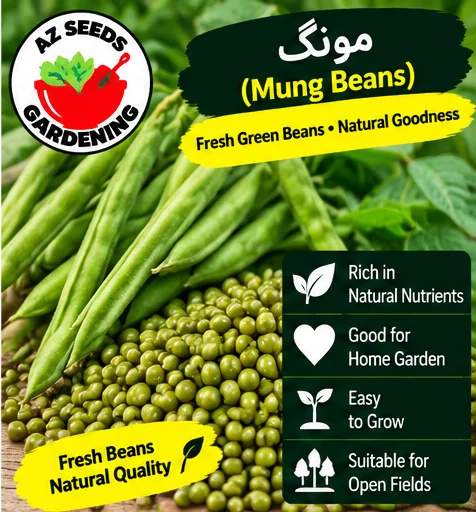
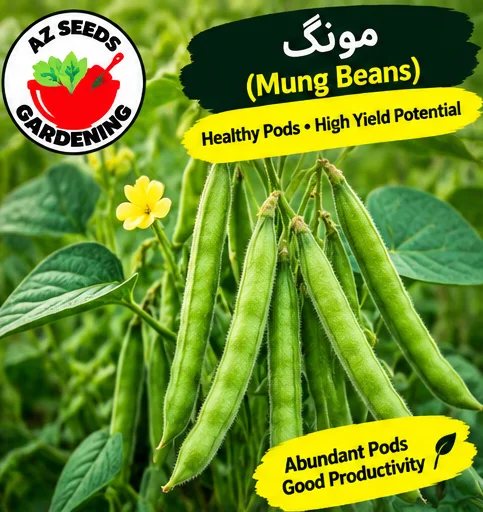
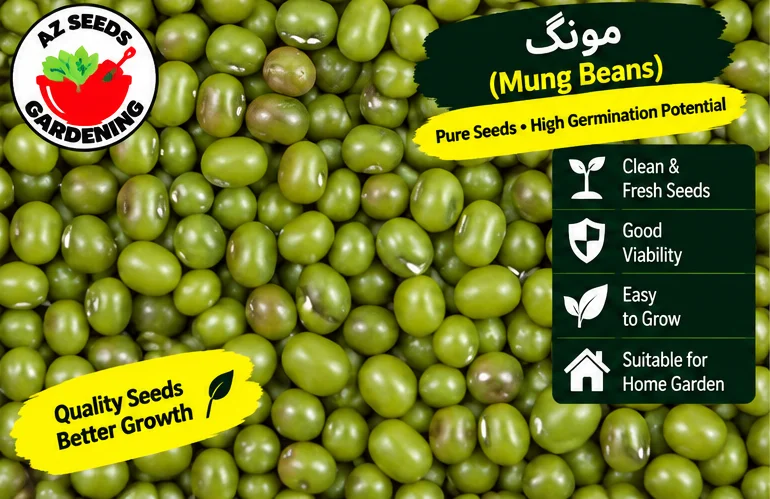
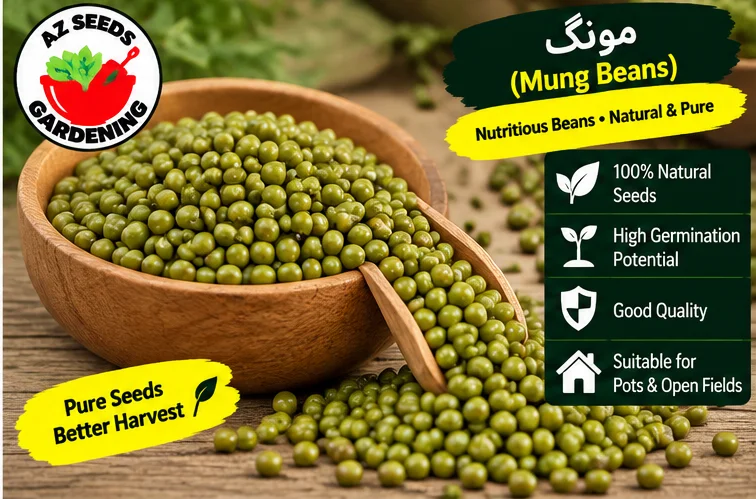
Mung Beans Seeds – Desi | WINTER / SUMMER | دیسی مونگ
₨ 100
Price: PKR 100 per pack
Approx. 100 seeds per pack.
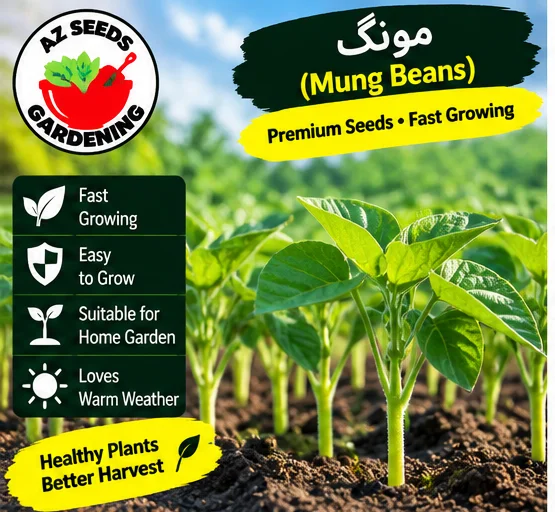
Image Disclaimer: Product images are AI-generated for visual representation only. Actual plants, fruits, vegetables, flowers, crops, colours, shapes, sizes, and appearance may vary depending on variety and growing conditions.
Image Disclaimer: Tamam product images AI-generated hain aur sirf visual representation ke liye hain. Asal poday, phal, sabzi, phool ya fasal ki shakal, rang, size aur overall appearance variety aur growing conditions ke mutabiq mukhtalif ho sakti hai.
Grow Desi Mung Beans / Green Gram / Moong (دیسی مونگ) from seeds supplied by AZ Seeds & Gardening.
Mung Bean is a warm-season annual legume botanically known as Vigna radiata. Plants generally develop branched stems, trifoliate leaves, small flowers and slender pods containing seeds.
It can be cultivated in kitchen gardens, raised beds, open soil and appropriately sized grow bags where adequate sunlight, drainage and plant spacing are available.
Common Name: Mung Bean / Moong / Green Gram / دیسی مونگ
Seed Type: Desi
Pack Size: Approx. 100 seeds
Botanical Name: Vigna radiata
Plant Family: Fabaceae
Crop Type: Warm-season annual legume
Growth Habit: Generally upright to somewhat spreading, depending on seed line and conditions
Germination: Generally approximately 4–8 days under suitable warm conditions
Practical Temperature Reference: Approximately 20–35°C
Suggested Pakistan Sowing Period: Generally February–April and July–September, adjusted according to local climate
Sunlight: Approximately 6–8 hours of direct sunlight daily
Soil pH Reference: Approximately 6.0–7.5
Description
Desi Mung Bean is an annual legume that develops vegetative growth followed by flowering and pod formation.
Plants generally develop:
- Branched stems
- Trifoliate leaves
- Small flowers
- Slender pods
- Seeds within mature pods
The exact plant height, branching pattern, flower colour, pod length, pod number, seed size, seed colour, maturity period and overall production can vary according to genetics and growing conditions.
Although the supplied source describes plants reaching approximately 60–75 cm, this should be treated only as a general reference rather than a guaranteed height for this Desi seed lot.
Key Features
- Desi Mung Bean / Moong Seeds
- 100 seeds per pack
- Botanical name: Vigna radiata
- Family: Fabaceae
- Warm-season annual legume
- Generally upright to somewhat spreading growth
- Develops trifoliate foliage
- Produces flowers followed by seed pods
- Suitable for direct sowing
- Suitable for spring cultivation
- Suitable for warm-season cultivation
- Suitable for late-summer / monsoon-period cultivation where local conditions permit
- Suitable for kitchen gardens
- Suitable for raised beds
- Suitable for open-ground cultivation
- Suitable for appropriately sized grow bags
- Suitable for rooftop gardening where adequate growing conditions are available
Important Desi Seed Information
This product is confirmed as:
Mung Beans / Moong – Desi (دیسی مونگ)
The term Desi does not automatically mean:
- Hybrid
- F1 Hybrid
- Certified Open-Pollinated seed
- Heirloom
- Organic
- Untreated
- Certified seed
- High yielding
- Fast maturing
- Drought tolerant
- Heat tolerant
- Disease resistant
- Pest resistant
- Uniform plant height
- Uniform pod size
- A particular registered cultivar
No such characteristic is claimed unless separately verified for this particular seed lot.
Plant Growth
Mung Bean plants generally begin with seedling establishment followed by vegetative development.
As plants mature, they may progress through:
- Seedling establishment
- Stem and leaf development
- Branching
- Flowering
- Pod setting
- Pod development
- Seed filling
- Seed maturity
Actual timing of each stage varies according to the seed line and growing environment.
Recommended Growing Locations
Desi Mung Beans may be grown in:
- Kitchen gardens
- Raised beds
- Open garden soil
- Agricultural plots
- Larger containers
- Grow bags
- Rooftop gardens
Open-ground cultivation provides greater flexibility for planting multiple plants with appropriate spacing.
Recommended Grow Bags
G-11 Grow Bag – 11 × 10 inch
May be suitable for a small planting where appropriate spacing and root-zone conditions are maintained.
G-12 Grow Bag – 12 × 12 inch
Provides additional growing-medium volume and may accommodate multiple appropriately spaced plants depending on actual plant development.
G-24 Grow Bag – 24 × 12 inch
Provides a wider planting area and may be more practical for growing a group of Mung Bean plants.
Exact plant capacity should not be treated as fixed.
Actual capacity depends on:
- Internal grow-bag dimensions
- Growing-medium volume
- Plant spacing
- Growth habit
- Irrigation
- Fertility
- General crop management
Avoid excessive overcrowding.
Recommended Soil / Growing Medium
Mung Beans generally perform well in loose, well-drained soil.
Loamy or sandy-loam soil can be suitable where drainage and fertility are appropriate.
A practical soil pH reference is approximately:
6.0–7.5
The growing medium should provide:
- Good drainage
- Suitable root aeration
- Moderate fertility
- Appropriate moisture retention
- Freedom from severe compaction
Bhalu Mitti and properly decomposed Vermicompost may be incorporated where appropriate.
A fixed 50% Bhalu Mitti + 50% Vermicompost mixture is not compulsory.
Adjust amendments according to existing soil conditions.
Growing Instructions from Seeds
1. Direct Sowing
Mung Beans are generally suitable for direct sowing into their final growing position.
Direct sowing avoids unnecessary transplant disturbance.
Prepare the soil so it is loose and adequately drained before planting.
2. Sowing Depth
Sow seeds approximately:
2–3 cm deep
Cover with fine soil and water gently.
Avoid unnecessarily deep planting.
3. Germination
Under suitable warm conditions, seeds may generally germinate within approximately:
4–8 days.
A temperature of approximately 20°C or above can provide suitable conditions for establishment, while the supplied cultivation information gives a broader practical temperature reference of approximately:
20–35°C
Actual germination time and percentage can vary according to:
- Seed age
- Storage
- Handling
- Temperature
- Soil moisture
- Sowing depth
- Soil condition
- Drainage
- Seed viability
100% germination is not guaranteed.
4. Seedling Care
After germination, provide:
- Adequate sunlight
- Suitable airflow
- Moderate moisture
- Warm growing conditions
- Good drainage
Thin excessive crowding if necessary.
Avoid disturbing established roots unnecessarily.
5. Plant Spacing
A practical spacing reference is approximately:
10–15 cm between plants
Additional space may be provided where plants develop more extensive branching.
Allow adequate space between planting rows or groups for:
- Air movement
- Plant development
- Crop inspection
- General maintenance
6. Sunlight
Provide approximately:
6–8 hours of direct sunlight daily
where practical.
Adequate sunlight supports normal:
- Vegetative growth
- Branch development
- Flowering
- Pod formation
- Seed development
Avoid prolonged deep shade.
Pakistan Sowing Season
Mung Bean is primarily a warm-season crop.
For many areas of Pakistan, practical sowing windows may include approximately:
February–April
and
July–September
depending on local climate and cropping conditions.
However, Pakistan has considerable climatic variation.
Adjust sowing according to:
- Region
- Temperature
- Elevation
- Seasonal weather
- Rainfall
- Irrigation availability
- Local cropping practices
These periods should therefore be treated as general Pakistan sowing guidance rather than fixed nationwide dates.
Watering
Maintain suitable soil moisture during:
- Germination
- Seedling establishment
- Vegetative growth
- Flowering
- Pod formation
- Seed development
Avoid:
- Standing water
- Permanently saturated soil
- Poor drainage
- Repeated excessive irrigation
- Severe prolonged moisture stress
Mung Bean is particularly unsuitable for prolonged waterlogged conditions.
Water according to actual soil moisture and weather rather than following a rigid schedule.
Waterlogging Precaution
Good drainage is important for Mung Bean cultivation.
Prolonged saturation can interfere with healthy root development and may increase the risk of root-related problems.
Where rainfall is heavy:
- Maintain drainage
- Avoid low spots where water accumulates
- Do not irrigate automatically when soil is already wet
Feeding
Mung Bean belongs to the legume family (Fabaceae).
Avoid assuming that heavy nitrogen fertilizer is necessary.
Excessive nitrogen application may encourage unnecessary vegetative growth and may not be appropriate for balanced crop development.
Properly decomposed Vermicompost, compost or another suitable soil amendment may be incorporated according to existing soil fertility.
Additional fertilizer requirements should depend on:
- Existing soil fertility
- Plant condition
- Growth stage
- Soil type
- Previous fertilizer applications
No fertilizer program guarantees pod production or yield.
Legume Root Association
Like many legumes, Mung Bean can form root associations with compatible nitrogen-fixing bacteria under suitable conditions.
However, the extent of nodulation and biological nitrogen fixation depends on factors including:
- Presence of compatible soil bacteria
- Soil conditions
- Soil pH
- Moisture
- Crop history
- Seed treatment
- Overall plant health
Therefore, nitrogen fixation should not be treated as guaranteed for every planting.
Flowering
As plants mature, they enter the flowering stage.
The supplied crop description identifies the flowers as generally pale yellow.
Flowering time may vary according to:
- Genetics
- Temperature
- Sowing date
- Sunlight
- Moisture
- Nutrition
- General plant development
No exact flowering date is guaranteed.
Pollination
Mung Bean flowers are generally capable of self-pollination.
However, successful flowering does not guarantee that every flower will produce a pod.
Pod set may be affected by:
- Temperature
- Moisture
- Plant health
- Flower development
- Environmental stress
- Genetics
Pod Development
After successful flowering and pod set, slender pods develop and seeds begin forming inside them.
During this stage:
- Maintain appropriate moisture
- Avoid severe water stress
- Maintain drainage
- Monitor plant health
- Avoid excessive fertilizer
- Maintain suitable airflow
Exact pod length and seed number per pod may vary.
Plant Support
Mung Bean is generally an upright to somewhat spreading annual crop.
Heavy trellising is not automatically required.
Where a particular seed line develops more spreading growth or plants begin lodging, light support may be provided if necessary.
Growth habit should be judged according to the actual plants rather than assuming a fixed bush or climbing form.
Mulching
A light organic mulch may be applied after plants establish where appropriate.
Mulching may help:
- Reduce rapid moisture loss
- Suppress some weeds
- Moderate surface soil conditions
Keep heavy mulch slightly away from plant stems.
Weed Management
Control aggressive weeds, particularly during early crop establishment.
Weeds may compete with young Mung Bean plants for:
- Water
- Nutrients
- Sunlight
- Root space
Hand weeding may be practical for small home plantings.
Avoid damaging crop roots while removing weeds.
Pest & Plant-Health Monitoring
Monitor plants regularly for locally occurring pests and diseases.
Possible problems may include:
- Aphids
- Whiteflies
- Thrips
- Pod-feeding insects
- Leaf-feeding caterpillars
- Mites
- Leaf spots
- Powdery mildew-type symptoms
- Root problems
Useful management practices include:
- Appropriate spacing
- Good airflow
- Proper drainage
- Suitable irrigation
- Weed management
- Crop hygiene
- Crop rotation where practical
No specific pest or disease resistance is claimed for this Desi seed lot.
Pod & Seed Maturity
As pods mature, their appearance and moisture content change and the seeds inside continue developing.
Where seed is being allowed to reach full maturity, monitor the crop and pods regularly.
Mature pods should not be left unnecessarily exposed to prolonged wet conditions, as excessive moisture around maturity may adversely affect seed condition.
Harvest Timing
Harvest timing should be determined according to the actual developmental stage of the crop rather than relying on a fixed number of days.
The supplied information refers to approximately 60–65 days to maturity under favourable conditions, but this should be treated only as a broad reference and not as a guaranteed maturity period for this Desi seed lot.
Actual maturity may vary according to:
- Genetics
- Temperature
- Sowing date
- Moisture
- Soil fertility
- Sunlight
- Plant health
- Seasonal conditions
Seed Drying & Storage After Crop Maturity
Where mature seed is being retained for future agricultural use, allow it to reach appropriate maturity and dry it adequately before storage.
Remove visibly damaged material.
Store mature, dry planting seed in suitable conditions protected from:
- Excess moisture
- High humidity
- Contamination
- Pest damage
Because this product is identified as Desi rather than specifically verified OP seed, saved seed should not automatically be assumed to reproduce every characteristic identically in subsequent generations.
Crop Variability
Seeds and plants are biological products.
Natural variation may occur in:
- Germination
- Plant height
- Branching
- Leaf development
- Flowering time
- Pod formation
- Pod length
- Seed number
- Seed size
- Seed colour
- Maturity
- Overall yield
Environmental and crop-management conditions can further influence these characteristics.
Important Seed-Use Information
Seeds supplied by AZ Seeds & Gardening are intended for agricultural, horticultural and gardening purposes, including sowing and plant cultivation only.
The supplied Mung Bean sowing seeds themselves are not sold as food, animal feed, sprouting seed for consumption, edible-oil material, medicine or dietary supplements.
Do not:
- Eat or directly consume the supplied sowing seeds
- Use the supplied sowing seeds for food sprouting
- Feed the supplied seeds to animals
- Process the supplied seeds into food products
- Prepare beverages or extracts from the supplied seeds
- Use the supplied seeds for medicinal or therapeutic purposes
- Use the supplied seeds inconsistently with their intended sowing or cultivation purpose
These restrictions apply specifically to the supplied sowing seeds themselves and do not classify mature plant parts produced through cultivation.
Where seeds are specifically identified as treated, coated or otherwise processed, follow all packet warnings and handling instructions.
Germination & Growing Disclaimer
Seeds are biological products, and germination, plant growth, flowering, pod formation, seed development and overall crop performance naturally vary.
Information concerning germination time, temperature, sowing season, sowing depth, spacing, sunlight, watering, flowering and harvesting is provided as general cultivation guidance and not as a guarantee of results.
Actual performance may be affected by:
- Seed age, storage and handling
- Genetics and seed line
- Soil or growing medium
- Temperature and weather
- Season and sowing time
- Sowing depth
- Moisture and irrigation
- Drainage
- Sunlight
- Plant spacing
- Soil fertility
- Pollination and flower development
- Pests and diseases
- General crop-management conditions
AZ Seeds & Gardening does not guarantee 100% germination, exact plant height, growth rate, flowering time, pod size, seed size, maturity period, yield, drought tolerance, heat tolerance, disease resistance, pest resistance, uniformity or identical crop performance under all growing conditions unless a specific characteristic is expressly supported by verified information applicable to the particular seed line.
Reviews
There are no reviews yet.