
Pumpkin Seeds – Hybrid Halwa Kaddu | SUMMER | حلوہ کدو
October 11, 2026
Purple/Red Cabbage Seeds – F1 Hybrid | WINTER جامنی / سرخ بند گوبھی
October 11, 2026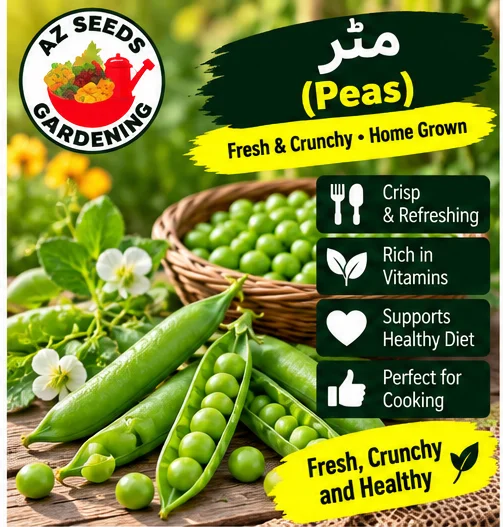
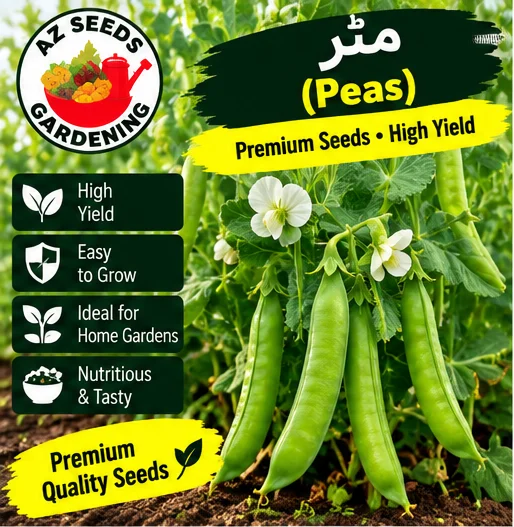
Green Peas Seeds – Desi | WINTER | دیسی مٹر
₨ 100
Price: PKR 100 per pack
Approx. 50–70 seeds per pack.
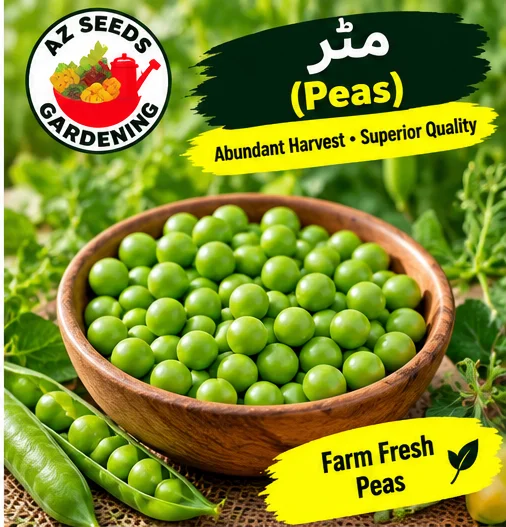
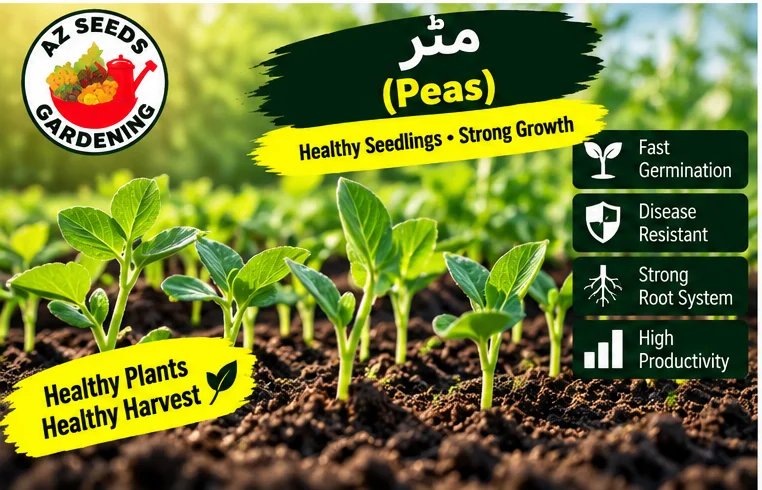
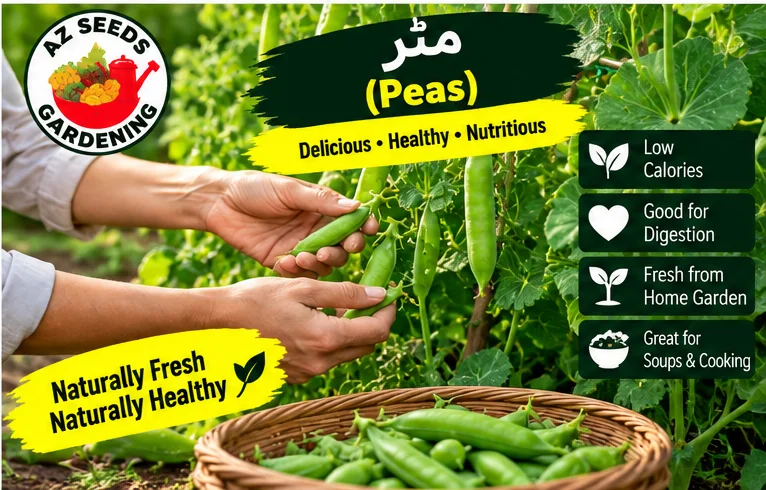
Image Disclaimer: Product images are AI-generated for visual representation only. Actual plants, fruits, vegetables, flowers, crops, colours, shapes, sizes, and appearance may vary depending on variety and growing conditions.
Image Disclaimer: Tamam product images AI-generated hain aur sirf visual representation ke liye hain. Asal poday, phal, sabzi, phool ya fasal ki shakal, rang, size aur overall appearance variety aur growing conditions ke mutabiq mukhtalif ho sakti hai.
Grow Desi Green Peas / Matar (دیسی مٹر) from seeds supplied by AZ Seeds & Gardening.
Green Pea (Pisum sativum) is a cool-season legume crop that develops green stems, compound leaves, climbing tendrils, flowers and pods containing developing peas.
Depending on the genetics of the seed line, pea plants may vary in height and growth habit. Because the exact cultivar and growth class of this Desi seed lot have not been separately verified, it should not automatically be classified as dwarf, semi-dwarf or tall climbing.
Providing suitable support is a practical option, particularly where plants develop a climbing habit.
Common Name: Green Peas / Desi Matar / دیسی مٹر
Seed Type: Desi
Pack Size: Approx. 50–70 seeds
Botanical Name: Pisum sativum
Crop Family: Fabaceae
Crop Type: Cool-season legume
Growth Habit: May vary according to seed line
Germination: Generally approximately 7–14 days under suitable conditions
Practical Growing Temperature Reference: Approximately 10–20°C
Suggested Pakistan Sowing Period: Generally November to mid-December, with regional adjustment
Sunlight: Approximately 6–8 hours of direct sunlight daily
Support: Trellis, netting, stakes or another suitable support may be provided where required
Description
Desi Green Peas are a winter-season crop suitable for home gardens, kitchen gardens, raised beds, open-ground cultivation and appropriately sized grow bags.
Plants generally develop:
- Green stems
- Compound foliage
- Tendrils
- Flowers
- Green pods
- Developing peas inside the pods
Plant height and climbing behaviour vary considerably among pea varieties.
Since the exact cultivar of this Desi seed lot has not been independently established, no fixed plant height, pod length, pea size or growth class is guaranteed.
Key Features
- Desi Green Pea Seeds
- 50–70 seeds per pack
- Botanical name: Pisum sativum
- Cool-season legume crop
- Develops green pods
- Suitable for winter cultivation
- Suitable for direct sowing
- Support may be beneficial depending on plant habit
- Suitable for home gardens
- Suitable for kitchen gardens
- Suitable for raised beds
- Suitable for open-ground cultivation
- Suitable for appropriately sized grow bags
- Suitable for rooftop gardening where adequate sunlight and support are available
- Suitable for vertical support systems where plant habit requires them
Important Desi Seed Information
This product is confirmed as:
Green Peas – Desi (دیسی مٹر)
The term Desi does not automatically mean:
- Hybrid
- F1 Hybrid
- Open-Pollinated certification
- Heirloom
- Organic
- Untreated
- Certified seed
- High yielding
- Disease resistant
- Pest resistant
- Heat tolerant
- Cold tolerant
- Dwarf
- Semi-dwarf
- Tall climbing
- Early maturing
- A particular registered cultivar
No such characteristic is claimed unless separately verified for this particular seed lot.
Plant Growth Habit
Pea varieties can differ substantially in growth habit.
Depending on genetics, plants may be:
- Relatively compact
- Medium growing
- Semi-climbing
- More strongly climbing
Because the exact growth class of this Desi seed lot has not been verified, observe the actual plants as they develop.
Where tendrils begin actively climbing, provide appropriate support.
Recommended Growing Locations
Desi Green Peas may be grown in:
- Open garden soil
- Kitchen gardens
- Raised beds
- Agricultural plots
- Larger pots
- Grow bags
- Rooftop gardens
Where plants develop climbing growth, ensure there is sufficient space for a suitable support structure.
Recommended Grow Bags
G-11 Grow Bag – 11 × 10 inch
May be suitable for a small number of appropriately spaced plants, depending on actual plant habit and root-zone requirements.
G-12 Grow Bag – 12 × 12 inch
Provides additional growing-medium volume and may be used with suitable support.
G-24 Grow Bag – 24 × 12 inch
Provides a wider growing area and may accommodate several appropriately spaced plants along a suitable support system.
Exact plant capacity should not be treated as fixed.
It depends on:
- Grow-bag dimensions
- Growing-medium volume
- Plant spacing
- Actual growth habit
- Support arrangement
- Irrigation
- Fertility
- General crop management
Avoid excessive overcrowding.
Recommended Soil / Growing Medium
Use a growing medium that is:
- Loose
- Well drained
- Reasonably fertile
- Well aerated
- Suitable for root development
- Capable of retaining adequate moisture without remaining saturated
A practical soil pH reference is approximately:
pH 6.0–7.5
Bhalu Mitti and properly decomposed Vermicompost may be incorporated where appropriate.
A fixed 50% Bhalu Mitti + 50% Vermicompost mixture is not compulsory.
Adjust soil amendments according to:
- Existing soil texture
- Fertility
- Drainage
- Organic-matter content
- Moisture retention
- Container size
Avoid continuously waterlogged soil.
Growing Instructions from Seeds
1. Direct Sowing
Peas are generally suitable for:
Direct sowing
Sow seeds directly into their intended growing position in prepared garden soil, raised beds or suitable grow bags.
Direct sowing also avoids unnecessary disturbance to young root systems.
2. Sowing Depth
A practical sowing depth is approximately:
4–5 cm
Cover with loose soil or growing medium and water gently.
Avoid excessive soil compaction over the seed.
3. Germination
Under suitable cool to mild conditions, seeds may generally germinate within approximately:
7–14 days
The source provides approximately 10°C and above as a useful soil-temperature reference for germination.
Avoid sowing into severely cold, saturated soil.
Actual germination time and percentage may vary according to:
- Seed age
- Seed storage
- Seed handling
- Temperature
- Soil moisture
- Sowing depth
- Growing medium
- Drainage
- Seasonal conditions
100% germination is not guaranteed.
4. Seedling Care
After germination, provide:
- Adequate sunlight
- Suitable airflow
- Reasonably consistent moisture
- Appropriate growing space
- Support where required
Young seedlings should also be monitored for locally occurring pests and physical damage.
5. Plant Spacing
A practical spacing reference is approximately:
5–8 cm between plants
when plants are being grown along an appropriate row or support system.
Actual spacing can be adjusted according to:
- Plant growth habit
- Support system
- Available growing area
- Airflow
- Cultivation method
Avoid severe overcrowding.
6. Sunlight
Provide approximately:
6–8 hours of direct sunlight daily
as a practical guideline.
Actual sunlight requirements and crop response may vary with temperature, season and local conditions.
Pakistan Sowing Season
Green Peas are primarily a cool-season crop.
For many areas of Pakistan, a practical sowing period is approximately:
November to mid-December
However, this should not be treated as a fixed nationwide planting window.
Pakistan has substantial variation in winter temperatures, so sowing time should be adjusted according to:
- Region
- Local temperature
- Elevation
- Seasonal weather
- Frost conditions
- Duration of cool weather
- Local cultivation practices
In warmer areas, suitable timing may differ from cooler or elevated regions.
Climbing Support
Pea plants commonly produce tendrils that can attach to nearby supports.
Depending on actual plant habit, suitable supports may include:
- Trellis
- Pea netting
- Bamboo sticks
- Vertical strings
- Suitable wire support
- Twiggy branches
- Garden frames
Where support is likely to be required, installing it early can reduce disturbance to established plants later.
Guide young growth gently where necessary.
Watering
Maintain reasonably consistent soil moisture during:
- Germination
- Seedling establishment
- Vegetative growth
- Flowering
- Pod setting
- Pod development
Avoid:
- Severe repeated drying
- Prolonged wilting
- Standing water
- Permanently saturated soil
- Poor drainage
Pay particular attention to moisture during flowering and pod development.
Water according to actual soil moisture and weather conditions rather than following a rigid schedule.
Feeding
Peas belong to the legume family.
Properly decomposed Vermicompost or another suitable organic amendment may be incorporated into the soil where appropriate.
Additional fertilizer should depend on:
- Existing soil fertility
- Plant condition
- Growth stage
- Previous fertilizer applications
Avoid unnecessarily heavy nitrogen fertilization.
Excessive nitrogen can encourage disproportionate vegetative growth.
No fertilizer program guarantees flowering, pod number, pea size or total yield.
Flowering & Pollination
Pea plants develop flowers as they reach the reproductive stage.
Garden peas are generally capable of a high degree of self-pollination, although actual fruit and seed development still depends on successful flower development and suitable growing conditions.
Flowering and pod set can be influenced by:
- Genetics
- Temperature
- Sunlight
- Moisture
- Plant health
- Nutrition
- Environmental stress
Prolonged high temperatures can negatively affect cool-season pea crops.
Pod Development
Following successful flowering, pods begin to develop and the seeds inside gradually enlarge.
During this stage:
- Maintain appropriate soil moisture
- Avoid severe plant wilting
- Monitor pests and diseases
- Maintain support where required
- Avoid damaging vines during maintenance
Exact pod length, number of peas per pod and pod production are not guaranteed for this Desi seed lot.
Mulching
A light organic mulch may be applied around established plants where appropriate.
Mulching may help:
- Reduce rapid moisture loss
- Suppress some weed growth
- Moderate surface soil conditions
- Protect soil structure
Keep heavy mulch slightly away from the main stems.
Weed Management
Keep the growing area reasonably free from aggressive weeds.
Weeds can compete with pea plants for:
- Moisture
- Nutrients
- Sunlight
- Root space
Remove weeds carefully to minimize root disturbance.
Pest & Plant-Health Monitoring
Inspect plants regularly for locally occurring pests and diseases.
Potential problems may include:
- Aphids
- Slugs
- Snails
- Caterpillars
- Birds
- Pea-related insect pests
- Powdery mildew
- Root rot
- Wilt
- Other locally occurring fungal or soil-borne problems
Useful management practices include:
- Appropriate spacing
- Good airflow
- Suitable irrigation
- Good drainage
- Weed management
- Crop hygiene
- Crop rotation where practical
No specific pest or disease resistance is claimed for this Desi seed lot.
Harvesting
Harvest timing should be determined according to actual pod and seed development rather than relying on a fixed number of days.
Pods may be monitored as they develop and harvested at the stage appropriate to the intended crop production.
Actual maturity varies according to:
- Genetics
- Temperature
- Sowing date
- Plant growth habit
- Soil
- Moisture
- Nutrition
- Sunlight
- Plant health
- General crop management
No exact maturity period is guaranteed for this Desi seed line.
Regular Harvesting
During active pod production, mature pods can be checked regularly and removed carefully as they reach the required stage.
When harvesting:
- Support the vine with one hand where necessary
- Remove pods carefully
- Avoid pulling or breaking stems
- Avoid unnecessary damage to flowers or developing pods
The exact duration and quantity of pod production will vary.
Crop Variability
Seeds and plants are biological products.
Natural variation can occur in:
- Germination
- Plant height
- Vine length
- Climbing behaviour
- Flowering time
- Flower colour
- Pod length
- Pod shape
- Number of peas per pod
- Pea size
- Maturity
- Overall yield
Environmental and crop-management conditions can further influence these characteristics.
Important Seed-Use Information
Seeds supplied by AZ Seeds & Gardening are intended for agricultural, horticultural and gardening purposes, including sowing and plant cultivation only.
The supplied Green Pea sowing seeds themselves are not sold as food, animal feed, edible-oil material, medicine or dietary supplements.
Do not:
- Eat or directly consume the supplied sowing seeds
- Feed the supplied seeds to animals
- Use the supplied seeds as pulses or food ingredients
- Process the supplied seeds into food products
- Extract edible oil from the supplied seeds
- Prepare beverages, extracts or supplements from the supplied seeds
- Use the supplied seeds for medicinal or therapeutic purposes
- Use the supplied seeds inconsistently with their intended sowing or gardening purpose
These restrictions apply specifically to the supplied sowing seeds themselves and do not classify mature plant parts produced through cultivation.
Where seeds are specifically identified as treated, coated or otherwise processed, follow all warnings and handling instructions appearing on the packet.
Germination & Growing Disclaimer
Seeds are biological products, and germination, plant development, flowering, pod formation and overall crop performance naturally vary.
Information concerning germination time, temperature, sowing season, sowing depth, spacing, sunlight, support and harvesting is provided as general cultivation guidance and not as a guarantee of results.
Actual performance may be affected by:
- Seed age, storage and handling
- Genetics and seed line
- Soil or growing medium
- Temperature and weather
- Season and sowing time
- Sowing depth
- Moisture and irrigation
- Drainage
- Sunlight
- Plant spacing
- Nutrition
- Flower development
- Pests and diseases
- General crop-management conditions
AZ Seeds & Gardening does not guarantee 100% germination, exact plant height, climbing habit, pod length, pea size, peas per pod, maturity period, yield, heat tolerance, cold tolerance, disease resistance, pest resistance, uniformity or identical crop performance under all growing conditions unless a specific characteristic is expressly supported by verified information applicable to the particular seed line.
Reviews
There are no reviews yet.