
Desi Onion Seeds دیسی پیاز | WINTER
October 11, 2026
Pak Choi Seeds – Open-Pollinated (OP) | WINTER | پک چوئے
October 11, 2026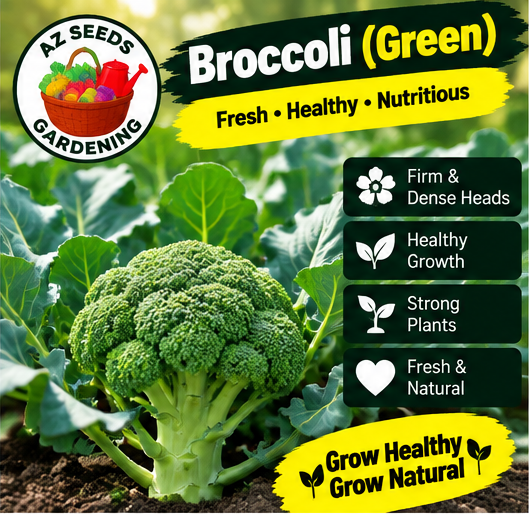
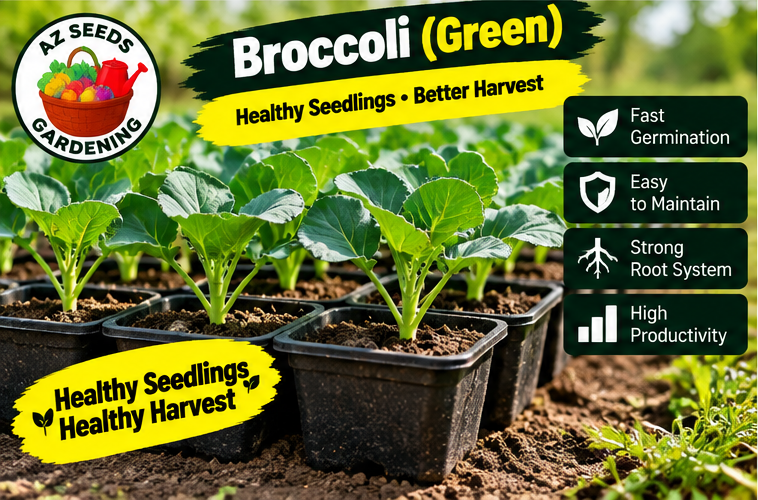
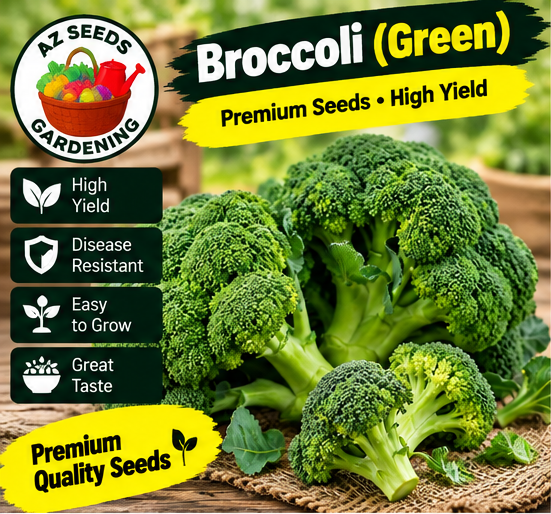
Broccoli Seeds – Open-Pollinated (OP) | WINTER سبز بروکلی
₨ 150
Price: PKR 150 per pack
Approx. 20-30 seeds per pack.
Image Disclaimer: Product images are AI-generated for visual representation only. Actual plants, fruits, vegetables, flowers, crops, colours, shapes, sizes, and appearance may vary depending on variety and growing conditions.
Image Disclaimer: Tamam product images AI-generated hain aur sirf visual representation ke liye hain. Asal poday, phal, sabzi, phool ya fasal ki shakal, rang, size aur overall appearance variety aur growing conditions ke mutabiq mukhtalif ho sakti hai.
Grow Broccoli from Open-Pollinated (OP) seeds supplied by AZ Seeds & Gardening.
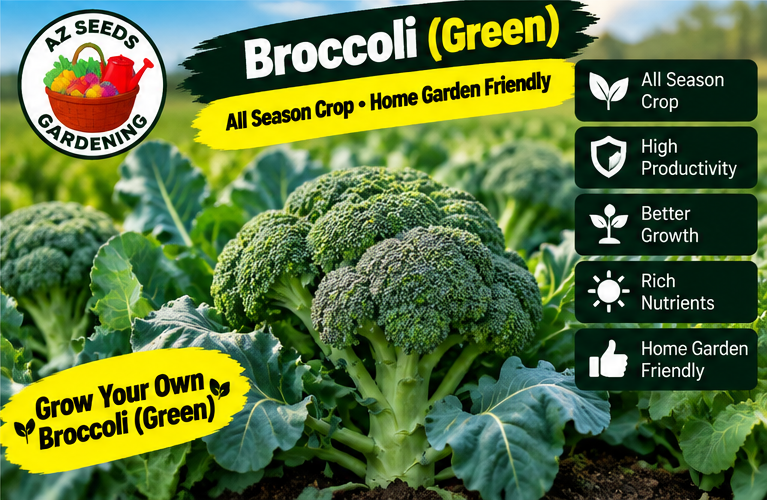
Broccoli is a cool-season Brassica crop grown primarily for the central green flower-bud head that develops above a leafy plant. Depending on genetics and growing conditions, some plants may also develop smaller side shoots after the main head is harvested.
Common Name: Broccoli
Seed Type: Open-Pollinated (OP)
Crop Family: Brassicaceae
Pack Size: Approx. 50 seeds
Crop Type: Cool-season Brassica
Germination Time: Generally approximately 5–10 days under suitable conditions
Suggested Sowing Period in Pakistan: Generally September–December, adjusted according to regional temperatures and seasonal conditions
Sunlight: Full sun preferred; approximately 5–6+ hours of direct sunlight can be used as a practical guideline
Description
Broccoli is a cool-season member of the Brassica family.
During vegetative development, plants generally form a substantial leafy structure. Under suitable conditions, a central cluster of tightly arranged flower buds develops into the characteristic broccoli head.
Depending on the particular OP seed population, environmental conditions and crop management, the exact:
- Plant height
- Plant spread
- Leaf size
- Leaf colour
- Head size
- Head shape
- Head density
- Head colour
- Growth rate
- Side-shoot development
- Maturity period
- Overall plant appearance
may vary.
Because this product is confirmed as Open-Pollinated (OP), it should not be represented as an F1 Hybrid.
Key Features
- Broccoli Seeds
- Open-Pollinated (OP)
- 50 seeds per pack
- Cool-season Brassica crop
- Develops a central flower-bud head
- Green foliage
- Suitable for autumn and winter cultivation
- Suitable for nursery raising
- Suitable for home gardens
- Suitable for raised beds
- Suitable for open-soil cultivation
- Suitable for appropriately sized pots and containers
- Suitable for larger grow bags
- Suitable for rooftop growing where environmental conditions are appropriate
- Some plants may develop additional side shoots after the central head is harvested
Important OP Seed Information
This product is confirmed as:
Open-Pollinated (OP) Broccoli Seeds
Open-Pollinated does not automatically mean:
- Desi
- Heirloom
- Organic
- Certified organic
- Untreated
- Disease resistant
- Pest resistant
- High yielding
- Genetically identical
- A registered cultivar
unless separately documented.
Natural variation may occur within an OP seed population.
Recommended Grow Bags
Broccoli requires sufficient growing-medium volume and growing space for normal root and above-ground development.
G-11 Grow Bag – 11 × 10 inch
May accommodate an individual plant where sufficient growing-medium volume, moisture and nutrition are maintained.
G-12 Grow Bag – 12 × 12 inch
Provides additional growing-medium volume and can be used for an individual established broccoli plant.
G-24 Grow Bag – 24 × 12 inch
Provides a wider planting area and may accommodate multiple plants where appropriate spacing and growing-medium volume are maintained.
The exact number of plants suitable for a grow bag depends on:
- Internal grow-bag dimensions
- Growing-medium volume
- Desired plant size
- Plant spacing
- Root development
- Moisture
- Nutrition
- Environmental conditions
Avoid excessive overcrowding.
Recommended Soil / Growing Medium
Use fertile, loose and well-drained soil or growing medium containing suitable organic matter.
The growing medium should provide:
- Good drainage
- Adequate aeration
- Reasonable moisture retention
- Suitable fertility
- Sufficient root-zone depth
Properly decomposed Vermicompost and Bhalu Mitti may be incorporated where appropriate.
However, a fixed:
50% Vermicompost + 50% Bhalu Mitti
mixture is not compulsory.
Adjust organic matter and other amendments according to:
- Existing soil texture
- Fertility
- Drainage
- Moisture retention
- Growing system
Avoid hard compaction and continuously waterlogged conditions.
Growing Instructions from Seeds
1. Prepare the Growing Medium
Prepare a fine, loose, fertile and well-drained growing medium.
Broccoli seeds can be started in:
- Seedling trays
- Nursery cells
- Nursery beds
- Suitable small containers
Direct sowing may also be possible where environmental and management conditions are suitable.
2. Sowing Depth
Sow seeds approximately:
0.5–1 cm deep
Cover lightly with fine soil or growing medium.
Avoid unnecessarily deep sowing.
Water gently after sowing to minimize seed displacement.
3. Germination
Under suitable conditions, seeds may generally germinate within approximately:
5–10 days
Actual germination time and percentage can vary according to:
- Seed age
- Seed storage
- Handling
- Temperature
- Soil moisture
- Sowing depth
- Growing medium
- Drainage
- Weather conditions
Maintain reasonable moisture during germination without keeping the growing medium continuously saturated.
100% germination is not guaranteed.
4. Seedling Care
After emergence, provide:
- Suitable light
- Adequate airflow
- Consistent but controlled moisture
- Sufficient growing space
- Appropriate cool-season conditions
Thin severely overcrowded seedlings where necessary.
Monitor young seedlings for pest damage and abnormal development.
5. Transplanting
Nursery-grown seedlings may be transplanted once they are healthy, sturdy and sufficiently established.
Approximately:
4–6 true leaves
can be used as a practical developmental guideline.
This should not be treated as an absolute transplanting requirement.
Transplant carefully to minimize unnecessary root disturbance.
Water appropriately after transplanting.
6. Plant Spacing
A practical starting range for established plants is approximately:
35–45 cm between plants
Actual spacing may be adjusted according to:
- Plant size
- Growing system
- Available growing area
- Container dimensions
- Local growing conditions
Adequate spacing helps provide growing room and airflow.
Avoid severe overcrowding.
7. Sunlight
Broccoli generally performs well in:
Full sun
Approximately:
5–6 hours or more of direct sunlight daily
can be used as a practical home-growing guideline.
Actual crop response can vary according to season, temperature and local environmental conditions.
Pakistan Sowing Season
Broccoli is fundamentally a cool-season crop.
For many areas of Pakistan, a practical sowing period is approximately:
September–December
This should be treated as a general seasonal guideline rather than a fixed nationwide calendar.
Adjust sowing according to:
- Local temperature
- Region
- Elevation
- Seasonal weather
- Frost conditions
- Late-season heat
- Local cultivation practices
Warmer and cooler regions of Pakistan can have different workable sowing periods.
Watering
Maintain reasonably consistent soil moisture during active plant growth and head development.
Water according to actual soil conditions rather than following a rigid daily schedule.
Avoid:
- Prolonged severe drying
- Repeated wilting
- Standing water
- Permanently saturated soil
- Poor drainage
Containers and grow bags may dry faster than open soil and therefore require regular moisture monitoring.
Adequate moisture supports normal crop development but does not guarantee a particular head size, head quality or yield.
Feeding
Properly decomposed organic matter such as Vermicompost may be incorporated before sowing or transplanting where appropriate.
Additional fertilizer should be based on:
- Existing soil fertility
- Growing medium
- Plant condition
- Growth stage
- Previous fertilizer applications
Balanced nutrition may be provided where required.
Avoid unnecessary excessive fertilizer application.
No fertilizer program guarantees a particular plant size, head size or yield.
Weed Management
Keep the growing area reasonably free from aggressive weeds.
Weeds can compete with broccoli plants for:
- Water
- Nutrients
- Sunlight
- Root space
Remove weeds carefully to avoid unnecessary disturbance to crop roots.
Mulching
A light organic mulch may be applied around established plants where appropriate.
Mulching may help:
- Reduce rapid moisture loss
- Suppress some weeds
- Moderate root-zone conditions
- Reduce soil splash
Keep continuously wet mulch slightly away from plant stems.
Pest Monitoring
As a Brassica crop, broccoli may be affected by various pests depending on local conditions.
Monitor plants for pests such as:
- Aphids
- Flea beetles
- Caterpillars
- Brassica-feeding larvae
- Whiteflies
- Slugs
- Snails
Inspect foliage regularly, including the undersides of leaves.
Pest occurrence and severity vary according to:
- Location
- Season
- Weather
- Surrounding vegetation
- Crop management
No resistance to any particular pest is claimed for this OP seed lot.
Disease & Plant-Health Monitoring
Monitor plants for symptoms such as:
- Leaf spotting
- Yellowing
- Wilting
- Abnormal leaf development
- Root decline
- Stem or crown problems
- Unusual plant deterioration
Brassica crops can be affected by different diseases and physiological problems under suitable environmental conditions.
General crop-management practices include:
- Appropriate plant spacing
- Suitable irrigation
- Adequate drainage
- Good airflow
- Weed management
- Crop hygiene
- Crop rotation where practical
Similar symptoms may result from disease, pests, nutritional problems or environmental stress.
Correct diagnosis is important before choosing a management response.
No resistance or tolerance to any specific disease is claimed for this OP seed lot.
Head Development
As plants mature under suitable conditions, the central growing region develops the characteristic broccoli flower-bud head.
Head development can be affected by:
- Genetics
- Temperature
- Plant age
- Moisture
- Nutrition
- Sunlight
- Plant spacing
- Root-zone conditions
- General plant health
The exact head:
- Size
- Shape
- Density
- Colour
- Development rate
can vary.
No exact head weight or dimensions are guaranteed for this OP seed population.
Warm-Weather & Temperature Stress
Broccoli is generally better suited to cool-season cultivation.
Excessively warm conditions during important developmental stages may affect normal head development.
Plant response depends on:
- Genetics
- Temperature
- Plant age
- Season
- Moisture
- Nutrition
- Other environmental conditions
For this reason, sowing should be timed so that important growth and head-development stages occur under reasonably suitable cool-season conditions where possible.
Harvesting
Harvest the central broccoli head according to actual plant development.
A practical visual stage for harvesting is when the head is:
- Well developed
- Reasonably compact
- Composed of tightly closed flower buds
- Not yet showing extensive flower opening
Use a clean, sharp knife to remove the central head.
Avoid relying solely on a fixed number of days because maturity can vary according to the seed population and growing environment.
Side-Shoot Development
After the central head is harvested, some broccoli plants may develop smaller side shoots under suitable conditions.
Whether this occurs, and the amount of additional development, depends on:
- Genetics
- Plant health
- Temperature
- Moisture
- Nutrition
- Sunlight
- Season
- Harvesting method
- General growing conditions
Side-shoot production is therefore not guaranteed for every plant.
Important Information About OP Seeds
This product is confirmed as:
Open-Pollinated (OP) Broccoli Seeds
Where compatible plants and suitable pollination conditions are present, open-pollinated plants can reproduce through natural pollination.
However, broccoli can cross-pollinate with compatible Brassica crops under suitable conditions.
Therefore, seed saved from plants grown near compatible flowering Brassica crops may not necessarily produce identical plants in the next generation.
OP status alone does not guarantee genetic purity under uncontrolled cross-pollination.
Important Seed Information
Seeds supplied by AZ Seeds & Gardening are intended for agricultural, horticultural and gardening purposes, including sowing and plant cultivation only.
The supplied sowing seeds themselves are not sold as food, animal feed, edible-oil material, medicine or dietary supplements.
Do not:
- Eat or consume the supplied sowing seeds
- Feed the supplied seeds to livestock, poultry, pets or other animals
- Extract edible oil from the supplied sowing seeds
- Prepare beverages, extracts or supplements from the supplied seeds
- Use the supplied seeds for medicinal or therapeutic purposes
- Use the supplied seeds inconsistently with their intended agricultural or gardening purpose
These restrictions apply to the supplied sowing seeds themselves and do not classify the mature crop produced through cultivation.
Where a seed packet is specifically identified as treated, coated or otherwise processed, follow all warnings and handling instructions appearing on that packet.
Germination & Growing Disclaimer
Seeds are biological products, and germination, plant development and crop performance naturally vary.
Information concerning germination time, sowing season, sowing depth, spacing, sunlight, transplanting, head development, side-shoot production and harvesting is provided as general cultivation guidance and not as a guarantee of results.
Actual performance may be affected by:
- Seed age, storage and handling
- Genetics and seed line
- Soil or growing medium
- Temperature
- Weather and climate
- Season and sowing time
- Sowing depth
- Moisture and irrigation
- Drainage
- Sunlight
- Plant spacing
- Nutrition
- Transplanting
- Pests and diseases
- Harvesting practices
- General crop-management conditions
AZ Seeds & Gardening does not guarantee 100% germination, exact plant size, head size, head shape, head colour, head density, growth rate, maturity period, side-shoot production, yield, disease resistance, pest resistance, uniformity or identical crop performance under all growing conditions unless a specific characteristic is expressly supported by verified information applicable to the particular seed line.
Reviews
There are no reviews yet.