
Beetroot Seeds – Hybrid | Deep Red Winter | چقندر
October 11, 2026
Golden Ball Turnip Seeds – Hybrid | WINTER | پیلی شلجم
October 11, 2026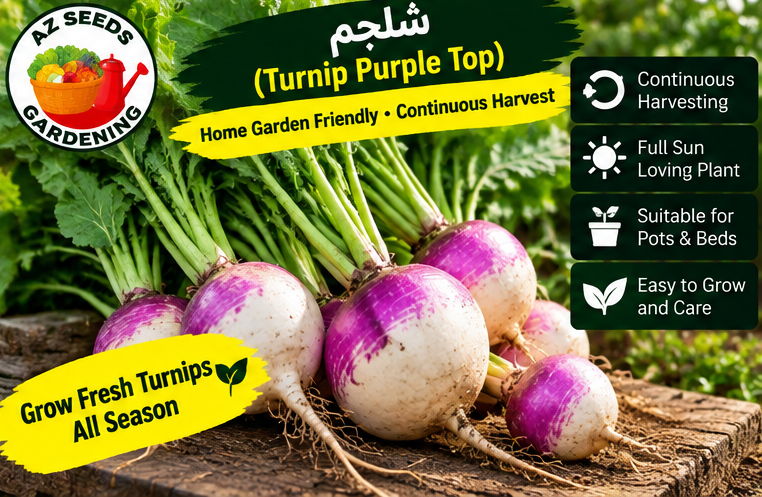
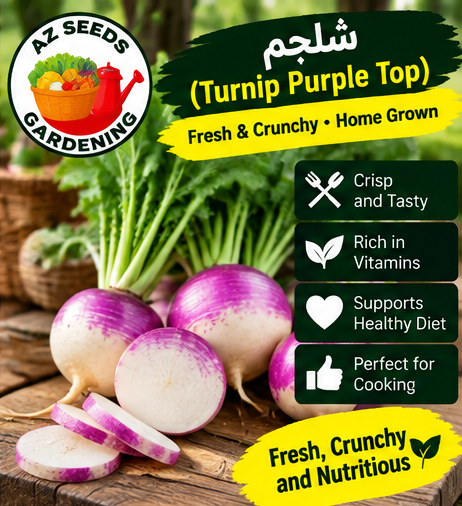
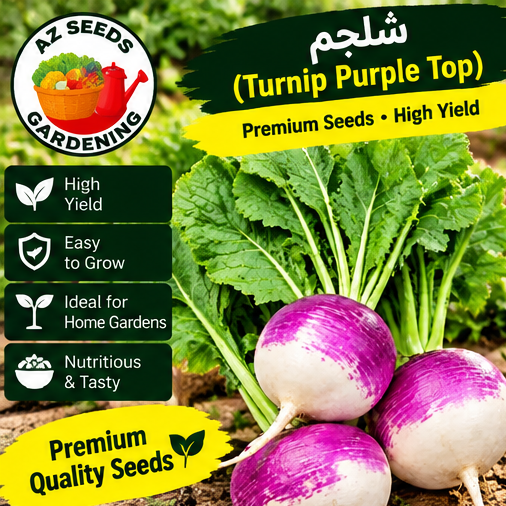
Purple Top Turnip Seeds – Hybrid | WINTER | شلجم
₨ 150
Price: PKR 150 per pack
Approx. 200 seeds per pack.
Image Disclaimer: Product images are AI-generated for visual representation only. Actual plants, fruits, vegetables, flowers, crops, colours, shapes, sizes, and appearance may vary depending on variety and growing conditions.
Image Disclaimer: Tamam product images AI-generated hain aur sirf visual representation ke liye hain. Asal poday, phal, sabzi, phool ya fasal ki shakal, rang, size aur overall appearance variety aur growing conditions ke mutabiq mukhtalif ho sakti hai.
Grow Purple Top Turnip – Hybrid (شلجم) from seeds supplied by AZ Seeds & Gardening.
Purple Top Turnip is a cool-season root vegetable generally recognized by its rounded to slightly flattened storage roots with purple colouring around the upper shoulder and creamy-white colouring on the lower portion.
The purple colour generally develops more strongly on the portion of the root exposed to light near or above the soil surface. Exact colour intensity, root shape, size and development may vary according to genetics and growing conditions.
Common Name: Purple Top Turnip / Purple Top Shaljam / شلجم
Seed Type: Hybrid — not claimed as F1 Hybrid
Pack Size: Approx. 300 seeds
Botanical Group: Brassica rapa / Turnip
Crop Family: Brassicaceae
Crop Type: Cool-season root vegetable
Root Type: Generally round to slightly flattened
Root Colour: Generally purple upper shoulder with creamy-white lower portion
Germination: Generally approximately 7–10 days under suitable conditions
Practical Temperature Reference: Approximately 10–22°C
Suggested Pakistan Sowing Period: Generally September–November, adjusted according to local climate
Sunlight: Approximately 6–8 hours of direct sunlight can be used as a practical guideline
Description
Purple Top Turnip is a Hybrid winter root crop suitable for direct sowing in home gardens, kitchen gardens, raised beds, open soil and appropriately sized grow bags.
Plants initially establish leafy growth while the storage root gradually enlarges close to the soil surface.
The characteristic root generally develops:
- Rounded to slightly flattened form
- Purple-coloured upper shoulder
- Creamy-white lower portion
- White interior
The upper portion of the developing root may naturally become visible above the soil surface. Exposure to light contributes to development of the characteristic purple shoulder.
Exact root colour, shape, diameter, maturity and overall crop performance can vary.
Key Features
- Purple Top Turnip Seeds
- Hybrid — not F1
- 300 seeds per pack
- Cool-season / winter root crop
- Generally round to slightly flattened roots
- Characteristic purple upper shoulder
- Generally creamy-white lower root
- White interior
- Suitable for direct sowing
- Suitable for autumn and winter cultivation
- Suitable for home gardens
- Suitable for kitchen gardens
- Suitable for raised beds
- Suitable for open-ground cultivation
- Suitable for appropriately sized grow bags
- Suitable for container and rooftop gardening where appropriate conditions are available
Important Hybrid Information
This product is confirmed as:
Purple Top Turnip – Hybrid
It is not being claimed as F1 Hybrid or Open-Pollinated (OP).
The term Hybrid alone does not automatically guarantee:
- F1 genetics
- High yield
- Faster maturity
- Disease resistance
- Pest resistance
- Heat tolerance
- Cold tolerance
- Exact root size
- Exact root shape
- Exact purple colour intensity
- Exact maturity period
- Uniform root development
- Identical crop performance
Such characteristics require separate verification for the particular seed line.
Purple Top Root Development
One of the recognizable characteristics of Purple Top Turnip is its two-tone root appearance.
The root generally develops a:
Purple upper shoulder + creamy-white lower portion
The purple pigmentation is typically strongest where the upper portion of the root receives light.
However, the exact:
- Shade of purple
- Area covered by purple colour
- White/cream colour
- Root diameter
- Root shape
- Root exposure above soil
may vary according to genetics and environmental conditions.
Recommended Growing Locations
Purple Top Turnip may be grown in:
- Open garden soil
- Kitchen gardens
- Raised beds
- Agricultural plots
- Containers
- Grow bags
- Rooftop gardens
Provide adequate root-zone space and avoid excessive plant crowding.
Recommended Grow Bags
G-11 Grow Bag – 11 × 10 inch
May be suitable for a compact planting where appropriate spacing is maintained.
G-12 Grow Bag – 12 × 12 inch
Provides additional growing-medium volume and may be useful for turnip root development.
G-24 Grow Bag – 24 × 12 inch
Provides a wider planting surface and may accommodate multiple appropriately spaced plants.
The exact number of plants per grow bag should not be treated as fixed.
Actual capacity depends on:
- Internal dimensions
- Growing-medium volume
- Plant spacing
- Root development
- Irrigation
- Soil fertility
- General crop management
Avoid overcrowding.
Recommended Soil / Growing Medium
Use a loose, fertile and well-drained growing medium that allows developing roots to expand with minimal physical obstruction.
The soil should preferably provide:
- Loose structure
- Good drainage
- Moderate fertility
- Suitable organic matter
- Reasonable moisture retention
- Root-zone aeration
- Minimal stones and hard clods
A practical soil pH reference is approximately:
pH 6.0–7.5
Bhalu Mitti and properly decomposed Vermicompost may be incorporated where appropriate.
A fixed 50% Bhalu Mitti + 50% Vermicompost mixture is not compulsory.
Adjust amendments according to:
- Existing soil texture
- Fertility
- Drainage
- Organic-matter content
- Moisture retention
- Container size
Avoid heavily compacted or continuously waterlogged soil.
Growing Instructions from Seeds
1. Soil Preparation
Prepare the growing area before sowing.
Remove:
- Large stones
- Hard soil clods
- Old roots
- Aggressive weeds
- Large plant debris
Loosen the soil sufficiently for developing storage roots.
Finish with a reasonably fine planting surface.
2. Direct Seed Sowing
Purple Top Turnip is generally well suited to:
Direct sowing
Sowing directly into the final growing position reduces unnecessary disturbance to developing roots.
3. Sowing Depth
Sow approximately:
1–1.5 cm deep
Cover lightly with fine soil or growing medium.
Water gently after sowing.
Avoid unnecessarily deep planting.
4. Germination
Under suitable conditions, germination may generally occur within approximately:
7–10 days
A practical temperature reference is approximately:
10–22°C
Actual germination time and percentage can vary according to:
- Seed age
- Storage
- Handling
- Temperature
- Moisture
- Sowing depth
- Soil conditions
- Drainage
- Seasonal weather
Keep the growing medium reasonably moist during establishment without allowing prolonged waterlogging.
100% germination is not guaranteed.
5. Seedling Care
After germination, provide:
- Suitable sunlight
- Reasonably consistent moisture
- Good airflow
- Adequate growing space
Avoid allowing seedlings to remain heavily overcrowded.
6. Thinning
Once seedlings establish, thin overcrowded plants where required.
A practical spacing reference is approximately:
5–8 cm between plants
Slightly wider spacing may be used where greater individual root development is desired.
Actual root size will still depend on genetics and growing conditions.
7. Row Spacing
For open-ground or raised-bed cultivation, approximately:
30–38 cm between rows
may be used as a practical reference where space allows.
Row spacing can be adjusted according to the cultivation system.
8. Sunlight
Provide approximately:
6–8 hours of direct sunlight daily
as a practical guideline.
Adequate light supports normal plant development and can contribute to pigmentation of exposed Purple Top shoulders.
Actual colour development may still vary.
Pakistan Sowing Season
Purple Top Turnip is primarily a cool-season crop.
For many areas of Pakistan, a practical sowing period is approximately:
September–November
Cultivation may also be possible during other suitably cool periods depending on region and local climate.
Adjust sowing according to:
- Local temperature
- Region
- Elevation
- Seasonal weather
- Frost conditions
- Extended warm periods
- Local cultivation practices
Therefore, September–November should be treated as a general Pakistan sowing guideline rather than a fixed nationwide requirement.
Watering
Maintain reasonably even soil moisture during:
- Germination
- Seedling establishment
- Early root formation
- Root enlargement
Avoid:
- Severe repeated drying
- Prolonged wilting
- Standing water
- Permanently saturated soil
- Poor drainage
Container-grown plants may require more frequent moisture monitoring.
Feeding
Properly decomposed Vermicompost or another suitable organic amendment may be incorporated where appropriate.
Additional fertilizer should depend on existing soil fertility and plant condition.
Avoid excessive nitrogen application because excessive vegetative growth may interfere with balanced root development.
No fertilizer program guarantees a particular root size or yield.
Root Development
As plants establish, the storage root gradually enlarges close to the soil surface.
The upper portion may naturally become exposed as the root develops.
Maintain:
- Loose soil
- Suitable plant spacing
- Reasonably consistent moisture
- Good drainage
- Appropriate fertility
- Weed control
Avoid deep cultivation close to established roots.
Weed Management
Keep the growing area reasonably free from aggressive weeds.
Weeds may compete for:
- Moisture
- Nutrients
- Sunlight
- Root space
Remove weeds carefully around developing roots to minimize crop disturbance.
Pest & Plant-Health Monitoring
Purple Top Turnip belongs to the Brassica crop group and may encounter locally occurring pests or diseases.
Potential problems may include:
- Aphids
- Flea beetles
- Caterpillars
- Whiteflies
- Root-feeding pests
- Leaf-feeding insects
- Locally occurring Brassica diseases
Regularly inspect plants for:
- Leaf damage
- Yellowing
- Wilting
- Spotting
- Pest activity
- Abnormal root development
Useful management practices include:
- Appropriate spacing
- Good drainage
- Suitable irrigation
- Weed control
- Crop hygiene
- Crop rotation where practical
- Adequate airflow
No specific pest or disease resistance is claimed for this Hybrid seed lot.
Harvesting
Harvest according to actual root development rather than relying solely on a fixed number of days.
The supplied source mentions approximately:
50–70 days after sowing
as a harvesting reference.
Because the exact maturity specification has not been verified for this particular Hybrid seed line, 50–70 days should be treated only as general guidance and not as a guaranteed maturity period.
Actual harvest timing may vary according to:
- Genetics
- Temperature
- Season
- Soil conditions
- Plant spacing
- Moisture
- Nutrition
- Root development
- General crop management
How to Harvest
When roots reach the desired development stage:
- Loosen the surrounding soil carefully where necessary.
- Hold the plant close to the crown.
- Lift the root carefully.
- Avoid forceful pulling where the soil is compacted.
Take care not to unnecessarily damage neighbouring developing roots.
Successive Sowing
Where seasonal conditions remain suitable, Purple Top Turnip may be planted in:
Small successive batches
rather than sowing the entire quantity on one date.
This can spread crop development and harvesting over a longer period.
Tips for Better Root Development
For healthy Purple Top Turnip development:
- Use loose soil
- Remove large stones before sowing
- Sow directly
- Avoid unnecessary root disturbance
- Thin overcrowded seedlings
- Maintain suitable spacing
- Keep moisture reasonably consistent
- Provide adequate sunlight
- Avoid excessive nitrogen
- Maintain good drainage
- Control aggressive weeds
- Monitor plants for pests and disease
- Harvest according to actual root development
Crop Variability
Seeds and plants are biological products.
Natural variation can occur in:
- Germination
- Leaf development
- Root shape
- Root diameter
- Purple pigmentation
- White/cream root colour
- Growth rate
- Maturity
- Overall yield
Environmental conditions may also influence root appearance and performance.
No exact root diameter, root weight, purple colour intensity, maturity period or yield is guaranteed.
Important Seed-Use Information
Seeds supplied by AZ Seeds & Gardening are intended for agricultural, horticultural and gardening purposes, including sowing and plant cultivation only.
The supplied Purple Top Turnip sowing seeds themselves are not sold as food, animal feed, edible-oil material, medicine or dietary supplements.
Do not:
- Eat or directly consume the supplied sowing seeds
- Feed the supplied seeds to animals
- Extract edible oil from the supplied seeds
- Prepare beverages, extracts or supplements from the supplied seeds
- Use the supplied seeds for medicinal or therapeutic purposes
- Use the supplied seeds inconsistently with their intended sowing or gardening purpose
These restrictions apply specifically to the supplied sowing seeds themselves and do not classify mature plant parts produced through cultivation.
Where seeds are specifically identified as treated, coated or otherwise processed, follow all warnings and handling instructions appearing on the packet.
Germination & Growing Disclaimer
Seeds are biological products, and germination, root development and overall crop performance naturally vary.
Information concerning germination time, temperature, sowing season, sowing depth, spacing, sunlight, root development and harvesting is provided as general cultivation guidance and not as a guarantee of results.
Actual performance may be affected by:
- Seed age, storage and handling
- Genetics and seed line
- Soil or growing medium
- Soil compaction
- Temperature and weather
- Season and sowing time
- Sowing depth
- Moisture and irrigation
- Drainage
- Sunlight
- Plant spacing
- Nutrition
- Pests and diseases
- General crop-management conditions
AZ Seeds & Gardening does not guarantee 100% germination, exact root size, root shape, purple colour intensity, root weight, maturity period, yield, heat tolerance, cold tolerance, disease resistance, pest resistance, uniformity or identical crop performance under all growing conditions unless a specific characteristic is expressly supported by verified information applicable to the particular seed line.
Reviews
There are no reviews yet.