
Pak Choi Seeds – Open-Pollinated (OP) | WINTER | پک چوئے
October 11, 2026
Flat Leaf Parsley Seeds – Open-Pollinated (OP) | WINTER|چپٹے پتوں والا پارسلے
October 11, 2026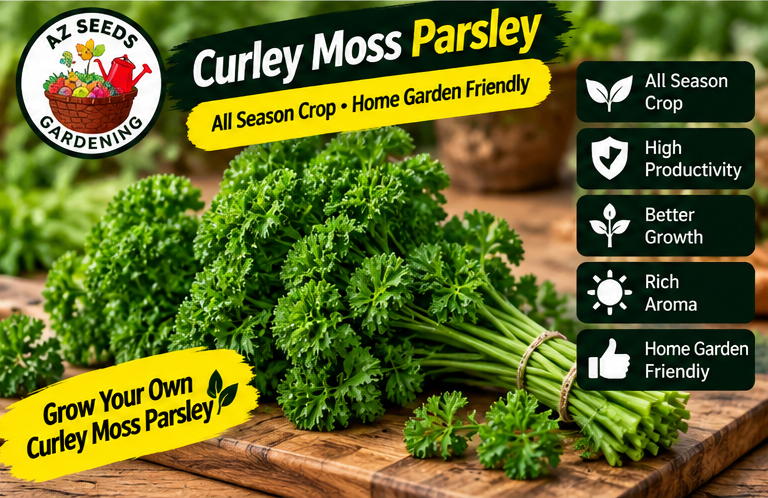
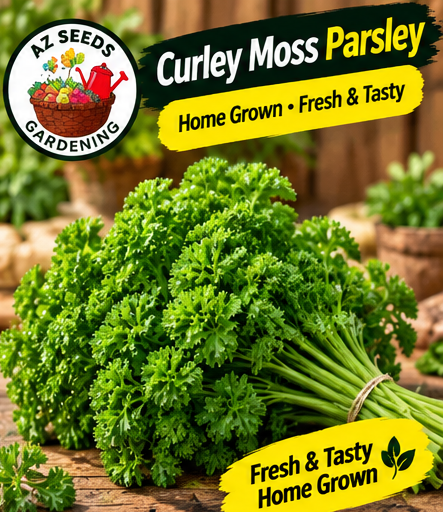
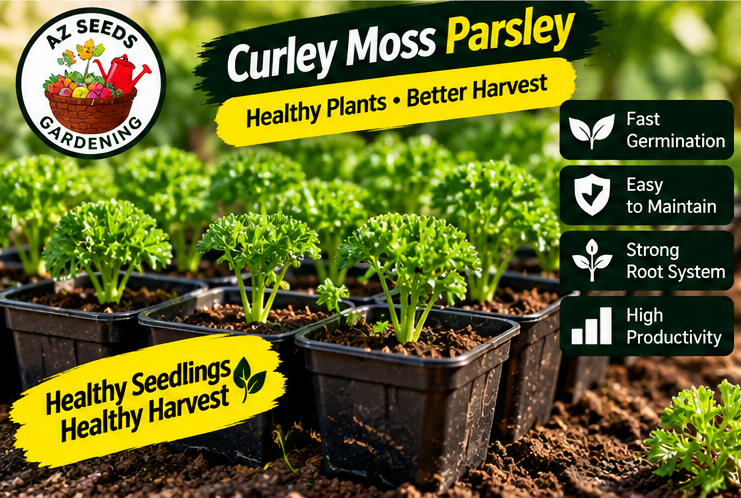
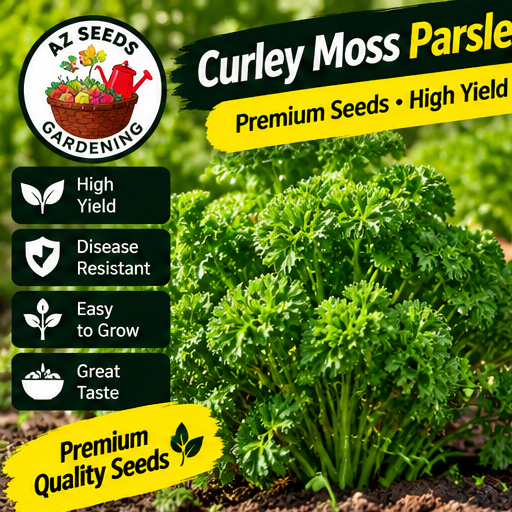
Curly Leaf Parsley Seeds – Open-Pollinated (OP) | WINTER گھنگریالے پتوں والا پارسلے
₨ 150
Price: PKR 150 per pack
Approx. 50-60 seeds per pack.
Image Disclaimer: Product images are AI-generated for visual representation only. Actual plants, fruits, vegetables, flowers, crops, colours, shapes, sizes, and appearance may vary depending on variety and growing conditions.
Image Disclaimer: Tamam product images AI-generated hain aur sirf visual representation ke liye hain. Asal poday, phal, sabzi, phool ya fasal ki shakal, rang, size aur overall appearance variety aur growing conditions ke mutabiq mukhtalif ho sakti hai.
Grow Curly Leaf Parsley (Petroselinum crispum) from Open-Pollinated (OP) seeds supplied by AZ Seeds & Gardening.
Curly Leaf Parsley is a cool-season leafy herb characterized by its distinctive curled green foliage. It can be grown in home gardens, raised beds, pots and appropriately sized grow bags.
Parsley is botanically a biennial plant. Under suitable conditions it generally develops vegetative foliage first and may flower and produce seed after exposure to the seasonal conditions that trigger its reproductive stage.
Botanical Name: Petroselinum crispum
Common Name: Curly Leaf Parsley
Seed Type: Open-Pollinated (OP)
Plant Type: Biennial herb
Foliage Type: Curled green leaves
Pack Size: Approx. 100 seeds
Crop Preference: Cool to mild growing conditions
Germination Time: Generally approximately 14–30 days under suitable conditions
Practical Germination Temperature: Approximately 18–21°C is suitable for seed starting
Suggested Sowing Period in Pakistan: Generally September–December, with adjustment according to local temperatures and regional climate
Sunlight: Full sun to partial shade; approximately 4–6 hours or more of suitable sunlight can be used as a practical home-growing guideline
Description
Curly Leaf Parsley belongs to the species Petroselinum crispum.
Its characteristic feature is its densely curled green foliage.
Parsley is naturally a biennial plant. Its growth and transition toward flowering can be influenced by plant age, temperature and seasonal conditions.
The exact:
- Plant height
- Plant spread
- Degree of leaf curling
- Leaf size
- Green colour intensity
- Growth rate
- Harvest period
- Flowering time
- Seed production
can vary according to genetics, season, climate and crop-management conditions.
Key Features
- Curly Leaf Parsley Seeds
- Open-Pollinated (OP)
- Botanical name: Petroselinum crispum
- 100 seeds per pack
- Biennial herb
- Distinctive curled foliage
- Green leafy growth
- Cool-season cultivation
- Suitable for direct sowing
- Suitable for nursery raising
- Suitable for home gardens
- Suitable for raised beds
- Suitable for pots and containers
- Suitable for appropriately sized grow bags
- Can grow in full sun to partial shade
- Foliage may be harvested progressively while plants remain healthy and actively growing
About Open-Pollinated Seeds
This product is confirmed as:
Open-Pollinated (OP)
Open-pollinated plants can reproduce through natural pollination.
However, OP status does not automatically mean:
- Heirloom
- Desi
- Organic
- Disease resistant
- Pest resistant
- Higher germination
- Higher yield
- Better quality
- Complete genetic uniformity
If seed saving is practiced, maintaining varietal characteristics can depend on appropriate pollination management and avoiding unwanted cross-pollination with compatible parsley plants.
Recommended Grow Bags
Parsley can be grown in pots and grow bags with suitable drainage and sufficient root depth.
G-8 Grow Bag – 8 × 8 inch
Can be used for a small parsley planting where plants are appropriately spaced and moisture and nutrition are managed.
G-11 Grow Bag – 11 × 10 inch
Provides additional growing-medium volume and can accommodate several plants where suitable spacing is maintained.
G-12 Grow Bag – 12 × 12 inch
Provides additional root-zone volume and moisture-holding capacity for a larger planting.
The exact number of plants that can be maintained successfully in any grow bag depends on:
- Actual internal dimensions
- Growing-medium volume
- Plant spacing
- Moisture management
- Nutrition
- Desired mature plant size
Avoid excessive overcrowding.
Recommended Soil / Growing Medium
Use fertile, loose and well-drained soil or growing medium containing suitable organic matter.
A practical approximate soil pH range is:
6.0–7.0
The growing medium should provide:
- Good drainage
- Adequate aeration
- Reasonable moisture retention
- Suitable fertility
- Sufficient root-zone depth
Bhalu Mitti and properly decomposed Vermicompost may be incorporated where appropriate.
However, a fixed:
50% Bhalu Mitti + 50% Vermicompost
mixture is not compulsory.
Adjust the amount of organic matter and other amendments according to the existing soil or growing medium.
Parsley benefits from reasonably consistent moisture but should not remain continuously waterlogged.
Growing Instructions from Seeds
1. Seed Sowing
Curly Leaf Parsley can be:
- Direct-sown
- Started in nursery trays
- Started in modules
- Started in small pots
- Sown directly into suitable containers or grow bags
Use a loose and well-drained seed-starting medium.
2. Sowing Depth
Sow seeds approximately:
0.5–1 cm deep
Cover lightly with fine growing medium.
Avoid unnecessarily deep sowing.
Water gently after sowing to avoid displacing the seeds.
3. Germination
Parsley can germinate relatively slowly compared with many common garden crops.
Under suitable conditions, germination may generally occur in approximately:
14–30 days
A practical seed-starting temperature around:
18–21°C
is suitable.
Some seeds may emerge earlier or later.
During germination:
- Maintain reasonably consistent moisture
- Avoid allowing the seedbed to remain severely dry for prolonged periods
- Avoid continuous saturation
- Maintain suitable aeration
- Protect the seedbed from unnecessary disturbance
100% germination is not guaranteed.
4. Seedling Care
After emergence, provide:
- Suitable light
- Adequate airflow
- Regular but controlled moisture
- Appropriate temperatures
Thin severely overcrowded seedlings where necessary.
Avoid keeping the growing medium continuously saturated.
5. Transplanting
Where parsley is started in trays or modules, transplant after seedlings become sufficiently established to handle safely.
A plant height of approximately:
10–15 cm
may be used as a practical reference in suitable conditions, but height alone should not determine transplant readiness.
Consider:
- Root establishment
- Number of developed leaves
- Seedling health
- Weather conditions
- Container size
Handle roots carefully during transplanting.
6. Plant Spacing
A practical spacing range is approximately:
15–30 cm between mature plants
depending on desired plant size and cultivation system.
Closer spacing may be used for smaller plants, while additional space can allow greater individual plant development.
Avoid excessive overcrowding because it can restrict airflow and increase competition for:
- Light
- Water
- Nutrients
- Root space
7. Sunlight
Curly Leaf Parsley can grow in:
Full sun to partial shade
Approximately:
4–6 hours or more of suitable sunlight
can be used as a practical home-garden guideline.
In areas experiencing strong heat, some protection from intense afternoon conditions may help reduce environmental stress.
Light requirements and heat response can vary with season and local climate.
8. Pakistan Sowing Season
Curly Leaf Parsley generally performs better under cool to mild growing conditions.
For many areas of Pakistan, a practical sowing period is approximately:
September–December
However, this is a general seasonal guideline rather than a universal calendar guarantee.
Adjust sowing according to:
- Local temperature
- Region
- Elevation
- Seasonal weather
- Frost conditions
- Extreme heat
- Local growing environment
In cooler locations, the workable planting period may differ from warmer lowland areas.
9. Watering
Maintain reasonably consistent soil moisture during active growth.
Water according to actual soil condition rather than following a rigid schedule.
Avoid:
- Prolonged severe drying
- Repeated wilting
- Standing water
- Continuously saturated soil
- Poor drainage
Containers and grow bags can dry more rapidly than open garden soil and may require more frequent monitoring.
10. Feeding
Before sowing or transplanting, properly decomposed organic matter such as Vermicompost may be incorporated where appropriate.
Additional feeding should depend on:
- Existing soil fertility
- Growing medium
- Plant condition
- Growth stage
- Previous fertilizer applications
Where plants show weak growth due to inadequate fertility, suitable balanced nutrition may be provided.
Avoid unnecessary excessive fertilizer applications.
11. Succession Sowing
Where a longer foliage-production period is desired, smaller batches may be sown at intervals during suitable cool-weather conditions.
This can help stagger plant development rather than having every plant at the same stage simultaneously.
The success of succession sowing depends on suitable seasonal conditions.
12. Mulching
A light organic mulch may be applied around established plants where appropriate.
Mulching may help:
- Reduce rapid moisture loss
- Suppress some weeds
- Moderate root-zone conditions
- Reduce rapid surface drying
Avoid piling continuously wet mulch directly against the central crown.
13. Weed Management
Keep the growing area reasonably free from aggressive weeds.
Young parsley can develop relatively slowly and may face competition from faster-growing weeds.
Weeds compete for:
- Water
- Nutrients
- Light
- Root space
Remove weeds carefully to avoid unnecessary disturbance of parsley roots.
14. Pest Monitoring
Inspect plants periodically for pests that may occur under local conditions, including:
- Aphids
- Caterpillars
- Leaf-mining insects
- Slugs
- Snails
Pest occurrence and severity vary according to location, season and environmental conditions.
No pest-resistance claim is made for this OP seed line.
15. Disease & Plant-Health Monitoring
Monitor plants for symptoms such as:
- Leaf spotting
- Yellowing
- Wilting
- Abnormal foliage
- Crown decline
- Root deterioration
- Unusual plant decline
Good cultivation practices include:
- Suitable spacing
- Appropriate irrigation
- Adequate drainage
- Air movement
- Weed management
- Removal of severely diseased plant material
- General garden hygiene
Continuously wet growing conditions can increase the risk of some root and foliage problems.
Similar symptoms can have different causes, so correct diagnosis is important before selecting a treatment.
No resistance or tolerance to any specific disease is claimed for this OP seed line.
Foliage Harvesting
Begin foliage harvesting after plants have developed sufficient healthy growth to tolerate removal.
For progressive harvesting:
- Select established outer stems
- Cut them carefully near their base
- Leave sufficient healthy central growth intact
- Avoid removing excessive foliage from young or stressed plants
Where growing conditions remain suitable and plants remain healthy, new foliage may continue developing after harvesting.
However, repeated or continuous production is not guaranteed.
Regrowth can depend on:
- Plant health
- Temperature
- Moisture
- Nutrition
- Light
- Season
- Harvesting intensity
- Plant age
Biennial Growth & Flowering
Parsley is botanically a biennial plant.
Under suitable environmental conditions, plants generally focus on vegetative growth initially and may later enter reproductive growth, producing flower stalks and seeds.
The timing of flowering can vary according to:
- Plant age
- Temperature exposure
- Season
- Genetics
- Local climate
- Environmental stress
Once plants enter reproductive growth, foliage characteristics and vegetative production may change.
No exact flowering date is guaranteed.
Important Information About OP Seeds
Open-pollinated seeds are capable of reproduction through natural pollination.
Seed saved from healthy OP plants may retain many characteristics of the parent population when appropriate isolation and seed-saving practices are followed, but absolute genetic uniformity should not be assumed.
Cross-pollination with compatible nearby plants and natural genetic variation can influence subsequent generations.
OP should not automatically be interpreted as:
- Heirloom
- Desi
- Organic
- Untreated
- Certified
- Disease resistant
- Pest resistant
unless separately documented.
Important Seed Information
Seeds supplied by AZ Seeds & Gardening are intended for agricultural, horticultural and gardening purposes, including sowing and plant cultivation only.
The supplied sowing seeds themselves are not sold as food, animal feed, edible-oil material, medicine or dietary supplements.
Do not:
- Eat or consume the supplied sowing seeds
- Feed the seeds to livestock, poultry, pets or other animals
- Extract edible oil from the seeds
- Prepare beverages, extracts or supplements from the seeds
- Use the seeds for medicinal or therapeutic purposes
- Use the seeds inconsistently with their intended agricultural or gardening purpose
Where a seed packet is specifically identified as treated, coated or otherwise processed, follow all warnings and handling instructions appearing on that packet.
Germination & Growing Disclaimer
Seeds are biological products, and germination, plant development and crop performance can naturally vary.
Information concerning germination time, temperature, sowing period, sowing depth, spacing, sunlight, transplanting, foliage development and harvesting is provided as general cultivation guidance and not as a guarantee of results.
Actual performance may be affected by:
- Seed age, storage and handling
- Genetics and seed line
- Soil or growing medium
- Temperature
- Weather and climate
- Season and sowing time
- Sowing depth
- Moisture and irrigation
- Drainage
- Sunlight
- Plant spacing
- Nutrition
- Pests and diseases
- Harvesting practices
- General crop-management conditions
AZ Seeds & Gardening does not guarantee 100% germination, exact plant size, leaf size, leaf colour, curl intensity, growth rate, foliage quantity, harvest period, regrowth, flowering time, seed production, disease resistance, pest resistance or identical crop performance under all growing conditions unless a specific characteristic is expressly supported by verified information applicable to the particular seed line.
Reviews
There are no reviews yet.